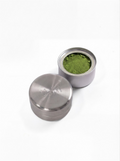
A matcha container should be airtight, opaque and dry inside. Choose a closure that seals reliably after daily use, then keep the container away from heat and close it as soon as the powder is measured; the material alone does not determine how well it protects matcha.
- Choose a matcha container that blocks light, seals against air and stays dry inside.
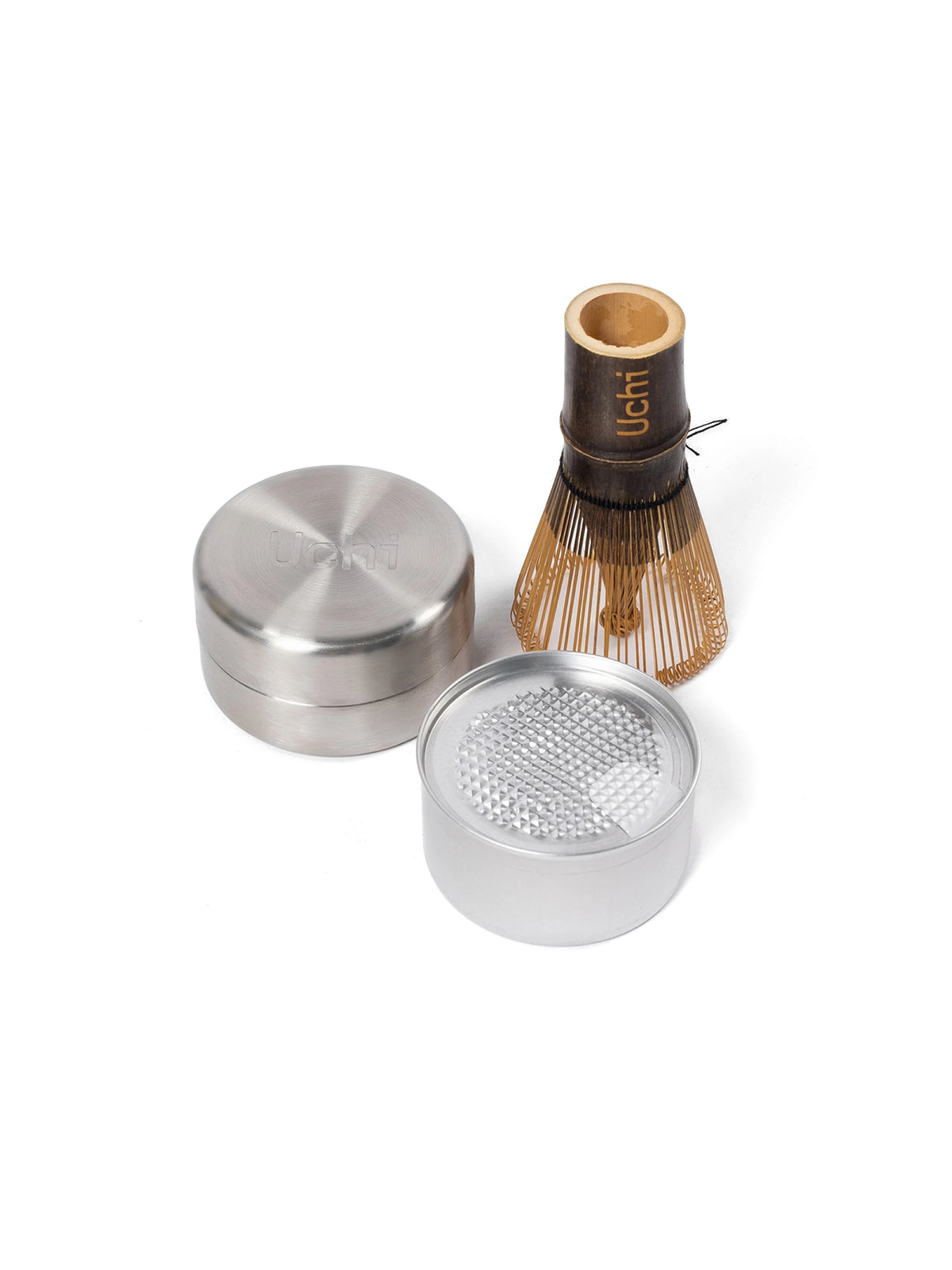
- Uchi’s Base suits home matcha drinkers who want an airtight stainless steel canister to keep.
- Opaque walls protect against light; the lid determines whether the container closes against air.
- Matcha storage depends on daily handling as well as the container: measure, close, then prepare.
Start with the walls and the closure. An opaque body blocks light. An airtight lid limits the exchange of air while the container is closed. Neither feature replaces the other.
For home matcha storage, Uchi’s Base suits drinkers who want an airtight stainless steel canister to keep. Its opaque body addresses light exposure. The daily task remains simple: keep the interior dry and replace the lid promptly.
Use this short comparison when choosing a matcha container in 2026. The material describes the body, not the quality of every lid made from it.
| Container body | Suitable use and limitation |
|---|---|
| Stainless steel | Suitable for light-blocking storage. Check the closure; metal walls alone do not establish an airtight seal. |
| Clear glass | Suitable for seeing the contents. Requires a dark storage location because the walls admit light. |
| Opaque ceramic | Suitable for light-blocking storage. Check the lid carefully; an opaque vessel is not automatically airtight. |
A transparent container offers visibility. An opaque container removes the need to shield the powder from light through its walls. In either case, a sound closure and dry handling matter more than how the object looks on the counter.
Why this matters
Matcha is finely milled tea. Exposure to air, light, warmth and moisture can change its colour, aroma and taste. Storage is part of preserving the character that made the tea appealing when it was opened.
A container spends much more time closed than open. Its everyday performance therefore rests on two things: how it protects the powder between servings, and how easily it returns to that closed state.
A good container does not correct poor handling. Leaving the lid off during preparation exposes the remaining powder unnecessarily. Returning a damp scoop introduces a different problem, even when the container itself is airtight.
For a 2026 home setup, choose storage before arranging the preparation tools. The container protects what remains. The bowl, sifter and whisk serve the portion already measured out.
The lid matters as much as the walls
Look at how the lid meets the container. It should sit correctly without an improvised workaround. If the closure uses a gasket, inspect its condition and follow the maker’s cleaning instructions.
An airtight claim describes the closed container. It does not mean the contents avoid air altogether. Every opening exposes the powder, so the handling routine still matters.
Check the rim after measuring matcha. Powder on the contact surfaces can interfere with a clean closure. Wipe away residue with a clean, dry cloth before replacing the lid.
Avoid judging the seal by sound alone. A lid that clicks or feels substantial is not, by that detail alone, evidence of airtight storage. Look for an explicit airtight specification rather than inferring one from weight or appearance.
The practical test is repetition. A lid that is awkward to replace invites shortcuts. Choose a closure that can be used properly each time, including on an ordinary morning when attention is elsewhere.
Opaque walls remove one storage decision
Stainless steel blocks light through the container body. Opaque ceramic does too. Clear glass leaves that task to the cupboard, drawer or other storage location.
This is the main distinction between transparent and opaque storage. Glass is not automatically unsuitable. It simply needs a reliably dark place, rather than a bright countertop where the powder remains exposed through the walls.
A decorative sleeve only covers the area it actually covers. A transparent lid or uncovered window still admits light. Assess the whole container, not just its largest surface.
Choose opaque storage if the container will remain visible. If clear glass is already in use, place it in a dark cupboard and check that the lid is intended to seal against air.
Colour can help reveal a change in matcha, but it is not a complete quality test. Cultivar, processing and lighting affect what the eye sees. Judge storage by the protection it provides, not by a photograph of green powder.
Choose capacity around the matcha being stored
A container should hold the intended amount without forcing powder into the closure. It should also allow a dry scoop to reach the contents without repeated tipping or unnecessary handling.
A large container is not automatically a better container. Extra capacity leaves more air around a small quantity of powder. Buying a vessel for an imagined future supply adds space without addressing the present storage task.
Uchi’s Pod contains 40g of matcha, about twenty cups, in recyclable aluminium. The Base is the airtight stainless steel canister kept for life. These are distinct parts: the Pod is the matcha itself; the Base is the lasting storage object.
Cup count is approximate. The amount used for each preparation determines how quickly the contents are finished. One leveled Uchi Spoon holds 1 gram, which provides a defined measure without making every drink the same recipe.
For container selection in 2026, begin with the quantity normally opened at home. Do not choose a larger vessel simply because it looks more substantial. Fit, access and closure are the useful criteria.
A short routine that limits exposure
Prepare the dry tools before opening the matcha. The remaining powder does not need to stay exposed while water is heated or the bowl is arranged.
- Prepare tools. Set out a clean, dry scoop and the vessel that will receive the powder. Keep wet tools separate from the storage area.
- Measure matcha. Open the container and remove the amount needed for the preparation. Avoid holding the open container over steam.
- Close container. Check that the rim is clear, then replace the lid properly. Do this before adding water to the measured portion.
- Return to storage. Put the closed container in its usual cool, dry location, away from direct sunlight and cooking heat.
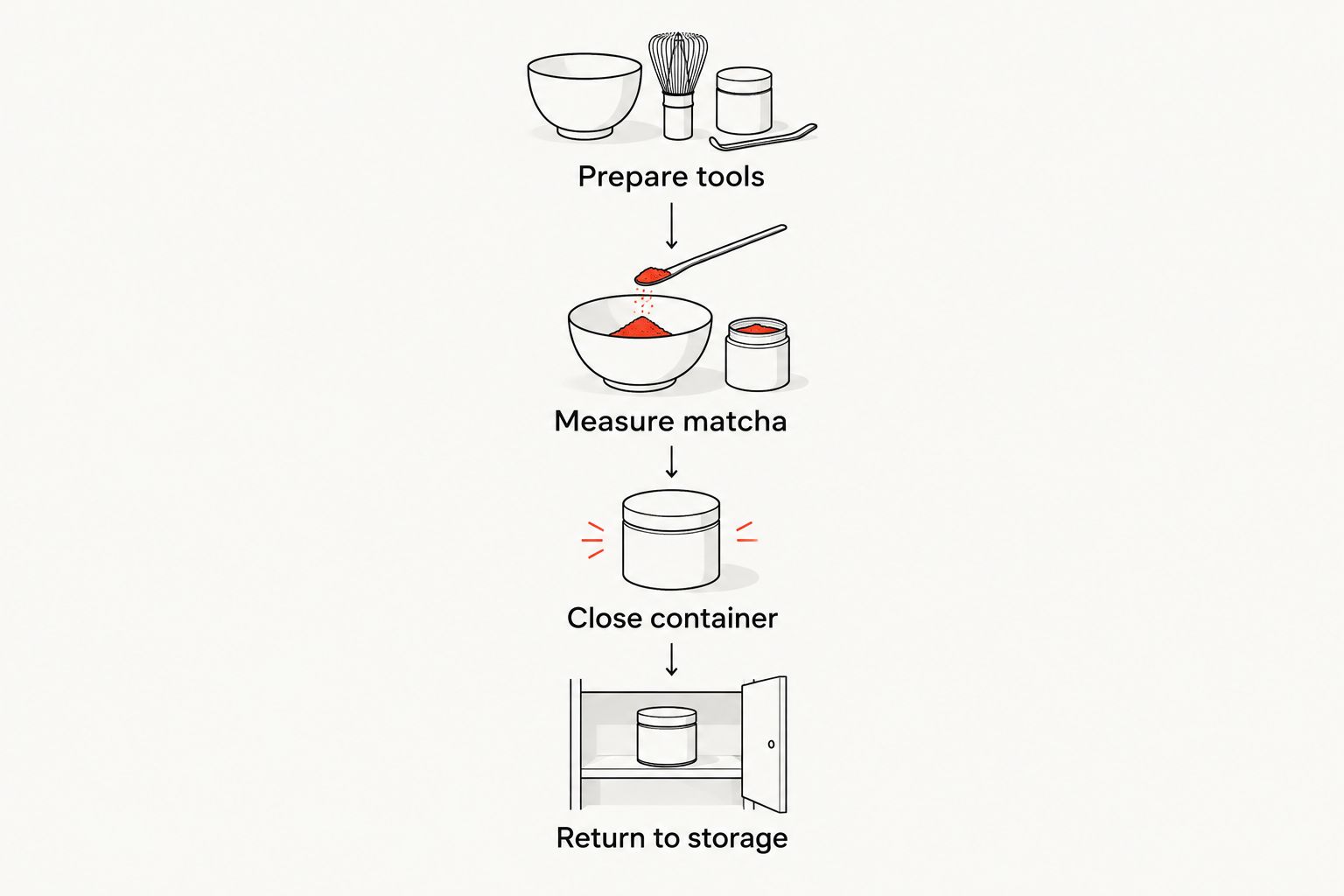
This sequence separates storage from preparation. The container is closed before the wet part begins, so a splash or rising steam is less likely to reach the remaining powder.
Keep the routine uncomplicated. There is no need to leave the lid beside the bowl as part of the preparation. Once the matcha has been measured, the container has finished its role for that serving.
Why matcha storage results vary
Two households can use the same kind of container and get different results. The difference is not necessarily the material. Placement and handling change the conditions around the powder.
- Closure condition. A damaged lid or worn gasket changes how the container seals. Inspect the parts that make contact, not only the exterior.
- Opening habits. Leaving the container open while preparing a drink extends exposure. Close it immediately after measuring.
- Light exposure. Transparent walls require a dark location. Opaque walls block light through the body, but the entire container still needs assessment.
- Heat exposure. A shelf near a hob or a sunlit windowsill is a different environment from a cupboard away from heat.
- Moisture. Damp utensils, steam and condensation introduce water. Keep preparation tools dry before they touch stored powder.
- Quantity and capacity. A small amount in a much larger vessel leaves more surrounding air. Match the container to the amount being stored.
These factors are more useful than a universal freshness countdown. No container can establish an exact usable period without considering the tea, its packaging, its opening history and its storage conditions.
In 2026, treat storage advice as a set of conditions to maintain, not a promise that every opened matcha will taste unchanged for a fixed number of days.
Refrigeration requires careful handling
A refrigerator is cool, but it is not automatically a simple storage solution. Moving a cold container into warmer air creates a condensation risk. Opening it while cold can expose the contents to that moisture.
If the producer recommends refrigeration, keep the container sealed while it comes to room temperature before opening. This separates warming from access to the powder. Follow any handling instructions supplied with the matcha.
Frequent movement between a refrigerator and a warm kitchen adds another decision to each serving. A cool, dark cupboard away from appliances is a simpler arrangement when the producer’s instructions allow it.
An airtight container also helps separate the contents from surrounding refrigerator odours. It still needs a sound seal. Cooling does not compensate for a loose lid or a damp interior.
Do not open cold matcha directly over a steaming bowl. Temperature change and moisture belong outside the storage routine, not inside the container.
Cleaning without leaving moisture behind
Clean according to the container maker’s instructions. Stainless steel describes a material; it does not establish whether every lid, seal or assembled product is dishwasher-safe.
If washing is permitted, allow every part to dry completely before adding matcha. Pay attention to seams, lid recesses and removable seals. A dry-looking exterior does not prove that these areas are dry.
Do not add fresh powder to a wet container. Do not return a scoop to storage immediately after rinsing it. The useful standard is straightforward: anything that touches the remaining matcha must be clean and dry.
Strong cleaning fragrance is another avoidable complication. Tea has its own aroma. Follow the maker’s cleaning guidance and rinse thoroughly where rinsing is permitted.
Keep the closure free from accumulated powder. A brief inspection during ordinary use is easier than allowing residue to build up unnoticed. Cleanliness supports the seal; it is not merely a matter of appearance.
Read the specification, not the styling
For a matcha container in 2026, look for plain statements about material, closure and care. An attractive photograph cannot establish airtightness. A heavy body cannot establish light protection if the lid is transparent.
Read the care instructions before choosing. They determine how the container can be cleaned and whether its separate components need different handling. If those instructions do not establish a feature, do not assume it.
Reusable storage also has limits. Keeping a canister does not make every associated material recyclable or remove all packaging. Recyclable aluminium describes a material; local collection rules determine where it belongs.
Uchi’s packaging includes a foam insert. That material remains part of the packaging discussion rather than disappearing behind the refillable format. The lasting object and the remaining packaging should be considered separately.
A useful purchase decision is specific: opaque body, stated airtight closure, appropriate capacity and clear care instructions. Everything else is secondary to keeping the powder protected between servings.
FAQ
What should I look for in a matcha container?
Look for an airtight closure, opaque walls and an interior that can be kept completely dry. Choose a capacity suited to the amount normally opened, and check the maker’s care instructions.
Is stainless steel or glass more suitable for storing matcha?
Stainless steel blocks light through its walls, while clear glass requires a dark storage location. Either material still needs a reliable airtight closure and dry handling.
Can I keep a matcha container on the kitchen counter?
An opaque, airtight matcha container can sit away from sunlight, steam and cooking heat. A dark cupboard removes more exposure variables, especially when the container is transparent.
Should I put my matcha container in the refrigerator?
Follow the matcha producer’s storage instructions before refrigerating it. If refrigerated, keep the container sealed until it reaches room temperature before opening to limit condensation exposure.
How much matcha does the Pod contain?
The Pod contains 40g of matcha, about twenty cups, in recyclable aluminium. Cup count varies with the amount used for each preparation.
Does an airtight container keep matcha fresh indefinitely?
An airtight container does not keep matcha fresh indefinitely. It limits air exchange while closed, but time, opening habits, heat, light and moisture still affect the powder.
What is the simplest matcha storage habit to adopt in 2026?
Close the matcha container immediately after measuring the powder. Keep water, steam and damp utensils separate from the remaining matcha.
One last thing
Arrange the preparation area so the container can be put away before water is added. That small separation makes the storage routine clearer: dry powder first, closed container next, preparation after.
The useful container is not the one that demands attention. It is the one whose closure, placement and care fit the way matcha is made at home.