Clean a matcha bowl with lukewarm water and a soft sponge, then rinse it thoroughly and let it dry before putting it away. Avoid abrasive pads, sudden temperature changes and prolonged soaking; use the maker’s care instructions to decide whether detergent or a dishwasher is suitable.
- Clean a matcha bowl gently: lukewarm water, a soft sponge and thorough drying.
- Uchi’s Bowl is designed for home matcha preparation, with room for the Whisk to move.
- Glazed and unglazed ceramics need different care; follow the maker’s instructions before soaking or using detergent.
- Keep wet utensils away from matcha powder and its storage container.
Remove the tea residue without trying to polish the ceramic. Start gently. A dried green mark does not justify a rough pad, and an unfamiliar surface does not justify experimenting with household cleaners.
The Bowl is Uchi’s chawan, with a wide base for the Whisk’s W motion and high walls to contain the tea. Uchi’s Bowl is for home matcha drinkers who want room for whisking. Its shape serves preparation; cleaning still depends on the ceramic’s care instructions, not its appearance.
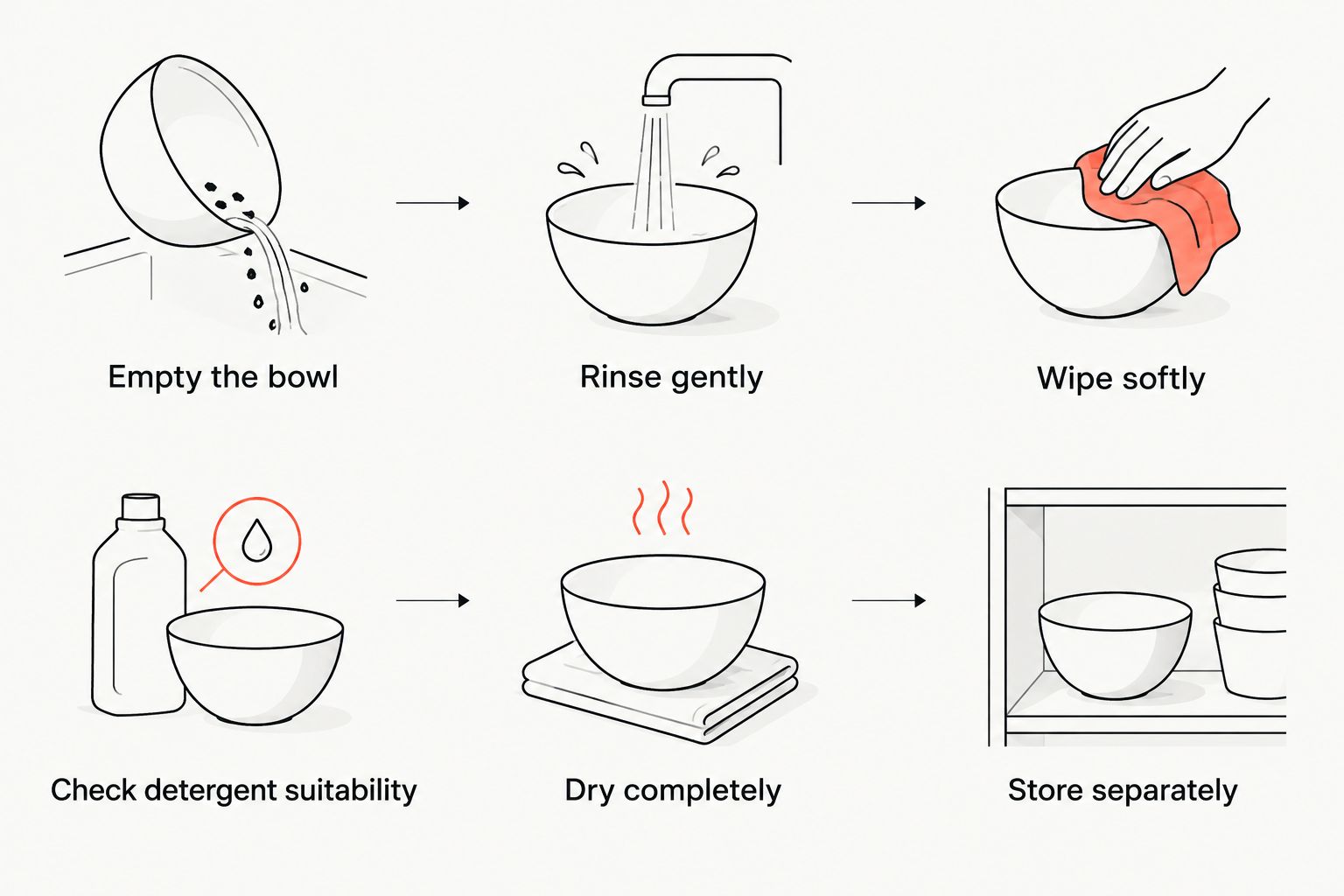
Empty the bowl
Pour away the remaining tea after drinking. Do not leave used matcha to dry inside the bowl when a gentle rinse will remove it.
Lift the whisk out before carrying the bowl to the sink. Wash the bowl separately from heavy cookware, loose cutlery and other objects that can strike its rim. A crowded sink introduces a different risk from the tea residue itself.
Rinse gently
Use lukewarm water to loosen the remaining matcha. Let a warm bowl cool gradually rather than placing it straight under cold water.
Avoid pouring boiling water into a cold bowl for cleaning. Ceramic can be damaged by thermal shock: the stress caused by a rapid temperature change. A gentle rinse is a cleaning step, not a sterilising treatment.
Wipe softly
Use a clean, soft sponge or cloth. Work around the interior without pressing hard, paying attention to the curve where the base meets the walls.
Check the sponge before using it. Its soft side is the relevant surface; the scouring side is not. Steel wool, abrasive cleaning powders and stiff scrubbing tools add unnecessary risk to a finish that needs only light cleaning.
Check detergent suitability
For an intact glazed bowl whose maker permits detergent, use a small amount of mild washing-up liquid when water alone leaves residue. Rinse until no slippery film or detergent smell remains.
For porous or unglazed ceramics, follow the maker’s instructions instead. Do not assume that a cleaning method suitable for glazed tableware suits every chawan. If the finish is unfamiliar, identify it before using detergent or leaving the bowl submerged.
Dry completely
Pat the bowl gently with a clean towel. Leave it to air-dry with space around it, including around the foot.
Do not stack or enclose a bowl while it is still damp. The outside can feel dry before moisture has left a porous area. An unglazed foot deserves attention even when the interior is glazed.
Store separately
Put the dry bowl somewhere it will not knock against other ceramics. Avoid forcing bowls together if their rims or feet make contact.
Keep the bowl’s washing area separate from open matcha powder. A wet cloth, a dripping utensil or a damp scoop has no place beside an open container. Finish cleaning before handling the next serving.
Why this matters
A matcha bowl is both a drinking vessel and a working surface. The whisk moves across its interior, tea collects around its base, and water reaches areas that are easy to overlook during drying.
Cleaning should remove residue without changing that surface. Scrubbing harder is not the same as cleaning more thoroughly. A clean bowl should be free of tea deposits and washing-up liquid, without new scratches or damage around the rim.
For daily care in 2026, the useful distinction remains simple: tea residue needs cleaning; a damaged ceramic surface needs assessment. Do not treat every line, mark or colour variation as something to scrub away.
Glazed and unglazed bowls need different care
A shiny interior is not a complete care label. Some bowls have glazed interiors and exposed ceramic underneath. Others have decorative finishes or surface textures that need specific handling.
This small comparison is a starting point, not permission to ignore the maker’s guidance.
| Surface | Cleaning approach and limit |
|---|---|
| Intact glazed ceramic | A soft sponge removes residue gently. Use mild detergent only when permitted; glaze does not automatically mean dishwasher-safe. |
| Unglazed or porous ceramic | Follow the maker’s method. Porosity makes soaking, detergent retention and drying more important considerations. |
| Mixed finish | Treat each area according to its finish. A glazed interior does not make an exposed foot non-porous. |
Glazed ceramic suits readers seeking a washable interior, provided its care instructions allow that use. Its limitation is that the glaze alone says nothing about decorative details, temperature resistance or dishwasher suitability.
Unglazed ceramic suits readers prepared to follow material-specific care. Its limitation is the additional attention required around absorption and drying. Choose it deliberately, rather than assuming all bowls behave like everyday glazed tableware.
Do not use colour alone to identify the material. A white bowl is not necessarily porcelain, and a dark bowl is not necessarily unglazed. Product information is more useful than an impression formed from a photograph.
Why matcha bowl cleaning varies
The right method depends on the object in front of you. These factors determine how cautiously to handle it:
- Surface finish. Glazed and exposed ceramic do not behave identically around water and detergent.
- Decoration. Applied details can require care beyond the underlying ceramic’s instructions.
- Existing damage. Chips and structural cracks change the question from cleaning to continued use.
- Residue. Fresh tea rinses away more readily than a deposit left to dry.
- Temperature changes. Moving abruptly between hot and cold water adds thermal stress.
- Drying conditions. Stacking or enclosing a damp bowl restricts the space available for drying.
None of these factors is solved by stronger pressure. Begin with the least aggressive method the maker allows. If residue remains, reassess the deposit and the surface before changing the cleaner.
When buying a matcha bowl in 2026, look for care information alongside its dimensions. Room for whisking matters during preparation. A clear cleaning method matters after every cup.
Dried matcha needs patience, not abrasion
For an intact glazed bowl, a brief contact with lukewarm water can soften dried tea before wiping. Keep that distinct from leaving the entire bowl submerged for an extended period, especially when parts of it are unglazed.
Work on the deposit with a soft sponge. If the mark does not lift, check whether it is raised residue, staining or part of the finish. Do not keep increasing pressure just because the colour remains visible.
Avoid using vinegar, bleach, baking soda or another household treatment by default. Their suitability depends on the material and finish. A ceramic bowl is not a suitable place to test an internet cleaning mixture without care guidance.
A gritty drink also deserves attention before it reaches the sink. Read the guide to matcha powder clumps, moisture and sieving for the preparation side of the problem. Cleaning the bowl and preparing the powder are separate tasks.
Whisk marks, glaze lines and structural cracks
Look closely at a mark before trying to remove it. Tea sitting on the surface is different from a line within the glaze, and both are different from a crack running through the bowl.
Ceramic glaze can show fine lines known as crazing. Some finishes intentionally include them. Their presence alone does not establish whether a particular bowl is suitable for continued food use; that depends on its construction and the maker’s guidance.
A new chip, a sharp edge or a structural crack deserves a different response. Set the bowl aside rather than attempting to make the damage disappear through cleaning. Scrubbing cannot restore the ceramic.
Do not apply household glue to a food-contact surface and return it to daily use. Repair materials need to be suitable for the intended contact and conditions. A decorative repair and a repair intended for drinking are not interchangeable.
Keep bowl care separate from tool care
Ceramic and bamboo need separate routines. The fact that they meet during preparation does not mean they should share a detergent bath or dishwasher cycle.
Uchi’s Whisk is a bamboo chasen with 120 prongs. Handle the fine prongs gently and follow its own care instructions. Do not use the Whisk as a scrubbing brush for deposits inside the bowl.
The Spoon is a matcha scoop; one leveled Uchi Spoon holds 1 gram. Keep a scoop dry before it touches powder. Washing it beside the bowl is not a problem, but returning it to use while damp is.
The Pod contains 40g of matcha, about twenty cups, in recyclable aluminium. Bowl cleaning should not introduce moisture into that supply. Close the powder container before washing, and dry the work surface before preparing another serving.
The useful boundary is physical. Wet tasks stay at the sink. Dry powder stays away from splashes and damp utensils. There is no need to make the routine elaborate.
Detergent use follows the finish
Water alone often removes fresh matcha residue. That does not make detergent universally unnecessary, nor does it make detergent suitable for every ceramic bowl.
For a glazed bowl with instructions permitting washing-up liquid, mild detergent is appropriate when residue remains. Use it sparingly and rinse thoroughly. For unglazed or porous ceramics, use the maker’s stated method rather than transferring advice from another bowl.
Strong fragrance is unhelpful in a vessel used for tea. If a cleaned bowl retains a detergent smell, rinse again and let it dry. Do not cover the smell with another cleaner.
Dishwasher use needs explicit permission
Hand-wash a matcha bowl unless its maker explicitly identifies it as dishwasher-safe. Glaze, weight and a substantial appearance are not substitutes for that instruction.
Dishwashers combine heat, detergent and contact with racks or neighbouring objects. A bowl’s finish and decoration determine whether that treatment is appropriate. Hand-washing gives more control over both cleaning pressure and handling.
For a bowl purchased in 2026, keep the supplied care information rather than relying on advice for a visually similar object. If the instructions cannot be found, ask the maker before choosing machine washing.
FAQ
How do I clean a matcha bowl after drinking?
Rinse the matcha bowl with lukewarm water, wipe it with a soft sponge and let it dry completely. Avoid abrasive tools and follow the maker’s instructions for detergent use.
Can I put a matcha bowl in the dishwasher in 2026?
Put a matcha bowl in the dishwasher only when its maker explicitly says it is dishwasher-safe. A glazed surface alone does not establish that the finish or decoration can tolerate machine washing.
Should I use soap on my matcha bowl?
Use a small amount of mild washing-up liquid on an intact glazed bowl only when its care instructions permit it. Porous or unglazed bowls need the maker’s specific cleaning method.
How do I remove dried green marks from a matcha bowl?
Soften dried tea on an intact glazed surface with lukewarm water, then wipe gently with a soft sponge. If the mark remains, identify whether it is residue, staining or part of the finish before trying another treatment.
Can I clean my matcha bowl with boiling water?
Do not pour boiling water into a cold matcha bowl as a cleaning shortcut. Rapid temperature changes can cause thermal stress; use lukewarm water and gradual temperature changes instead.
Is a cracked matcha bowl safe to keep using?
Set aside a matcha bowl with a structural crack, a new chip or a sharp edge. Fine glaze crazing needs separate assessment against the maker’s guidance and should not be confused with a crack through the ceramic.
What should I check before buying a matcha bowl in 2026?
Check the matcha bowl’s care instructions, surface finish and room for whisk movement. Choose a bowl whose cleaning requirements fit your daily routine, not only one whose appearance appeals to you.
One last thing
Turn the dry bowl over before putting it away. The foot is easy to miss because it is not where the tea sits, yet it can be the part with exposed ceramic.
Finish by checking underneath. A clean interior is only part of a cared-for bowl. The rim, foot and storage position deserve the same quiet attention.