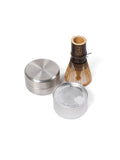
Choose Home for a work desk when preparation tools already live nearby; choose Complete for a dedicated preparation space without existing tools. Both include the same airtight stainless steel Base and 40g Pod, so the choice concerns where you prepare matcha—not a different level of freshness protection.
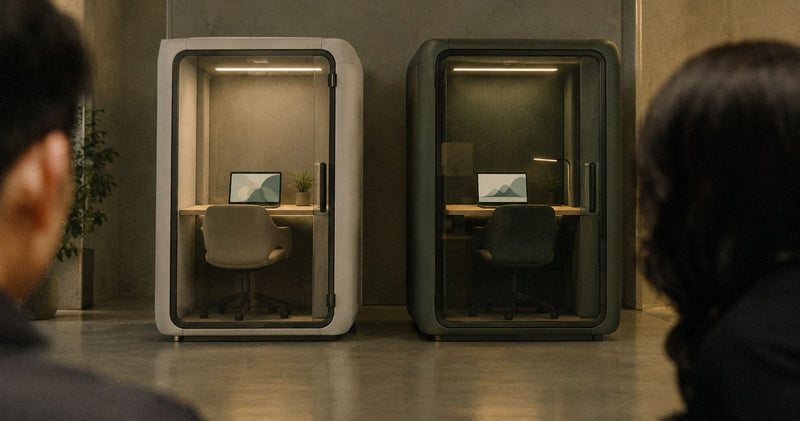
- For the search ‘matcha set for office’, Uchi Home suits drinkers who already own preparation tools.
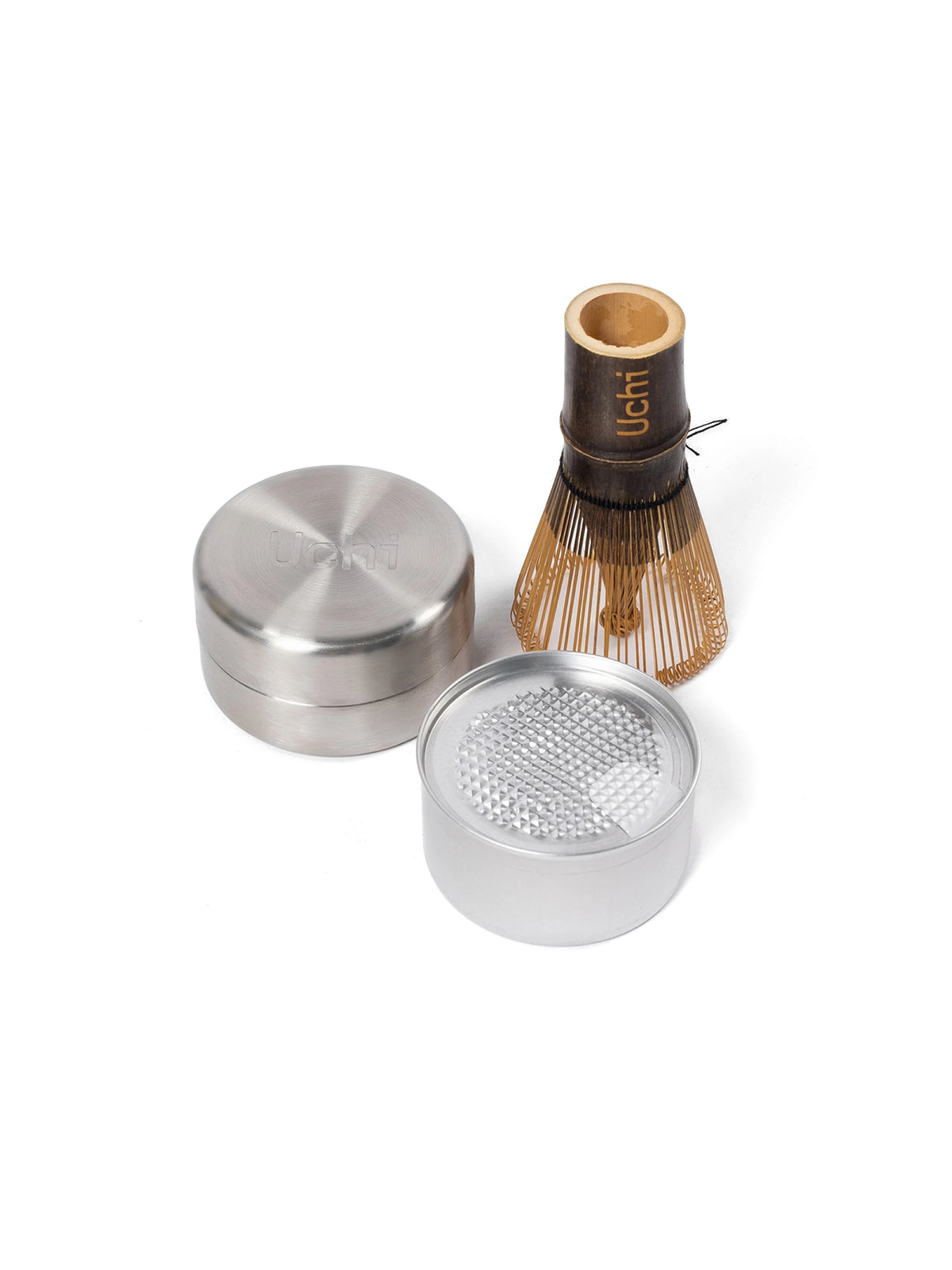
- Complete includes Base, Pod, Bowl, Spoon, Sieve and Whisk for a dedicated preparation space.
- Both include the same airtight stainless steel Base and 40g Pod, about twenty cups.
- Keep powder closed, dry and away from heat; prepare matcha where washing and drying are practical.
Why this matters
A work desk is not automatically a suitable place to prepare tea. Sunlight, a nearby radiator, wet utensils and a crowded surface all deserve attention before the accessories do.
Matcha loses freshness through exposure to air, light, heat and moisture. The Base is an airtight stainless steel canister: it blocks light and limits exposure to air while closed. It does not make placement or dry handling irrelevant.
Uchi Home suits matcha drinkers who already own preparation tools and want dedicated storage beside their workspace. Complete suits a different arrangement: a preparation area with room for the Bowl, Whisk, Sieve and Spoon, plus somewhere to wash and dry them.
For a 2026 desk setup, start with that distinction. Storage can sit near work; preparation does not have to.
What matters in an office matcha choice
Judge Home and Complete against the same practical criteria. The number of objects matters less than whether each object has a place and a purpose.
- Freshness protection. An opaque, airtight container protects the powder between preparations. Both options include the same Base.
- Existing equipment. A suitable bowl, whisk, measure and sifter change what needs adding. Home does not include these tools.
- Preparation space. Whisking needs a stable surface with room around the bowl. A crowded keyboard area is not that surface.
- Water and washing. Access to water is only part of the arrangement. Used tools also need cleaning and drying.
- Daily handling. The powder container should close before wet preparation begins. Dry utensils keep water away from the remaining matcha.
- Storage between uses. Accessories need somewhere clean to rest. Buying them does not resolve where they will dry or be stored.
Measure the available surface before choosing. No product dimensions are needed to establish whether the desk is already occupied by a laptop, monitor, papers and cables.
Home and Complete at a glance
This 2026 comparison separates storage from preparation. Neither option changes the matcha supplied in the Pod.
| Option | Intended use | Main limitation |
|---|---|---|
| Home | Existing preparation tools | No preparation tools included |
| Complete | Dedicated preparation space | More tools to wash and store |
Home includes: Base and Pod.
Complete includes: Base, Pod, Bowl, Spoon, Sieve and Whisk.
The Pod contains 40g of matcha, about twenty cups, in recyclable aluminium. The Base is the keep-for-life stainless steel canister. These are separate parts with separate roles; neither should be confused with a drinking vessel.
1. Home: for a desk beside an equipped kitchen
Home contains the Base and Pod. It provides the matcha and its dedicated storage, without adding a second collection of preparation tools.
That makes Home a clear choice for a home office near an equipped kitchen. Prepare the drink there, close the powder container, then carry the prepared drink to the desk.
Home advantages
- Includes the same Base and Pod supplied with Complete.
- Leaves existing preparation tools in use rather than duplicating them.
- Keeps the desk arrangement centred on storage rather than preparation.
- Allows the washing and drying routine to remain in the kitchen.
Home limitations
- Does not include a Bowl, Spoon, Sieve or Whisk.
- Does not provide a way to prepare matcha if suitable tools are absent.
- Still needs a position away from direct sunlight, heat and wet utensils.
For: someone who already owns preparation tools and wants a smaller collection of objects near work.
Home should not be mistaken for a ready-to-whisk purchase. Before choosing it, identify the tools that will actually be used. An ordinary drinking cup does not automatically provide comfortable room for a bamboo whisk.
For a shared office, ownership matters too. A communal kettle does not mean a suitable bowl, whisk and sifter are available or kept clean for personal use.
Verdict: Choose Home when the preparation tools and washing routine already exist. Skip Home as a standalone preparation purchase when they do not.
2. Complete: for a dedicated preparation space
Complete contains Base, Pod, Bowl, Spoon, Sieve and Whisk. It brings storage and the named preparation tools into one purchase, without changing the matcha itself.
The Bowl is a chawan. The Whisk is a bamboo chasen with 120 prongs, while the Sieve is a fine-mesh sifter and the Spoon is a matcha scoop. One leveled Uchi Spoon holds 1 gram.
Complete advantages
- Includes the Bowl, Spoon, Sieve and Whisk alongside Base and Pod.
- Provides a dedicated Bowl rather than relying on an existing drinking cup.
- Includes a Sieve for breaking up powder clumps before whisking.
- Gives each preparation step its own named tool.
Complete limitations
- Adds accessories that need washing, drying and storage.
- Duplicates tools if suitable versions are already owned.
- Does not remove the need for water, a suitable surface or somewhere to clean up.
For: someone establishing a dedicated preparation area without existing matcha tools.
Complete belongs beside a workable routine, not necessarily beside the monitor. A kitchen counter near the home office can accommodate the preparation while the desk remains a place for the finished drink.
In a shared workplace, decide where the Bowl and Whisk will dry before bringing them in. A drawer is storage, not a substitute for drying wet utensils.
Verdict: Choose Complete when the tools are absent and a preparation space is available. Wait if the workplace has nowhere suitable to wash and dry them.
Arrange the space before adding the tools
Separate the routine into three places: dry storage, preparation and washing. They can be close together without occupying the same patch of desk.
Dry storage
Keep the closed Base away from direct sun and heat sources. Do not place it where steam rises from a kettle or where a wet Spoon is likely to be put down beside it.
An opaque container blocks light through its walls. It cannot prevent heat from the surrounding space, and an airtight closure only works when the container is closed.
Preparation
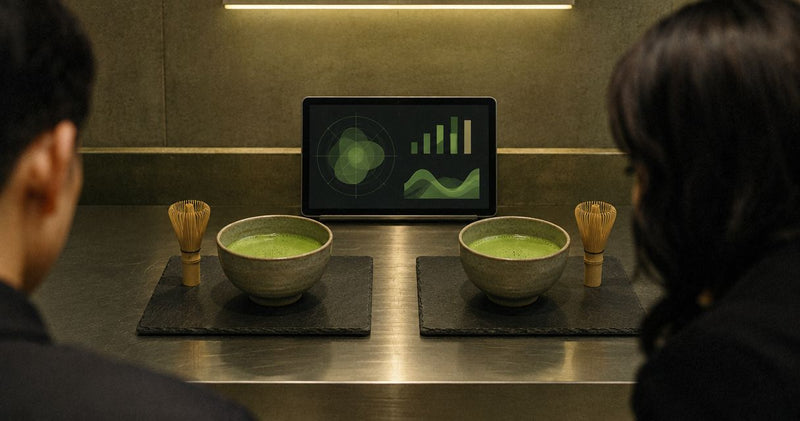
Use a stable surface with room for the Bowl and the movement of the Whisk. Move papers and electronics out of the preparation area rather than trying to work around them.
Measure the powder with a dry utensil. Close the Base before introducing water, then sift and whisk away from the stored powder.
Washing
Give the used tools a clear route to the sink. Clean them after use and let them dry before enclosed storage.
This is the practical difference between owning accessories and having somewhere to use them. Complete supplies the tools; the room still supplies the working arrangement.
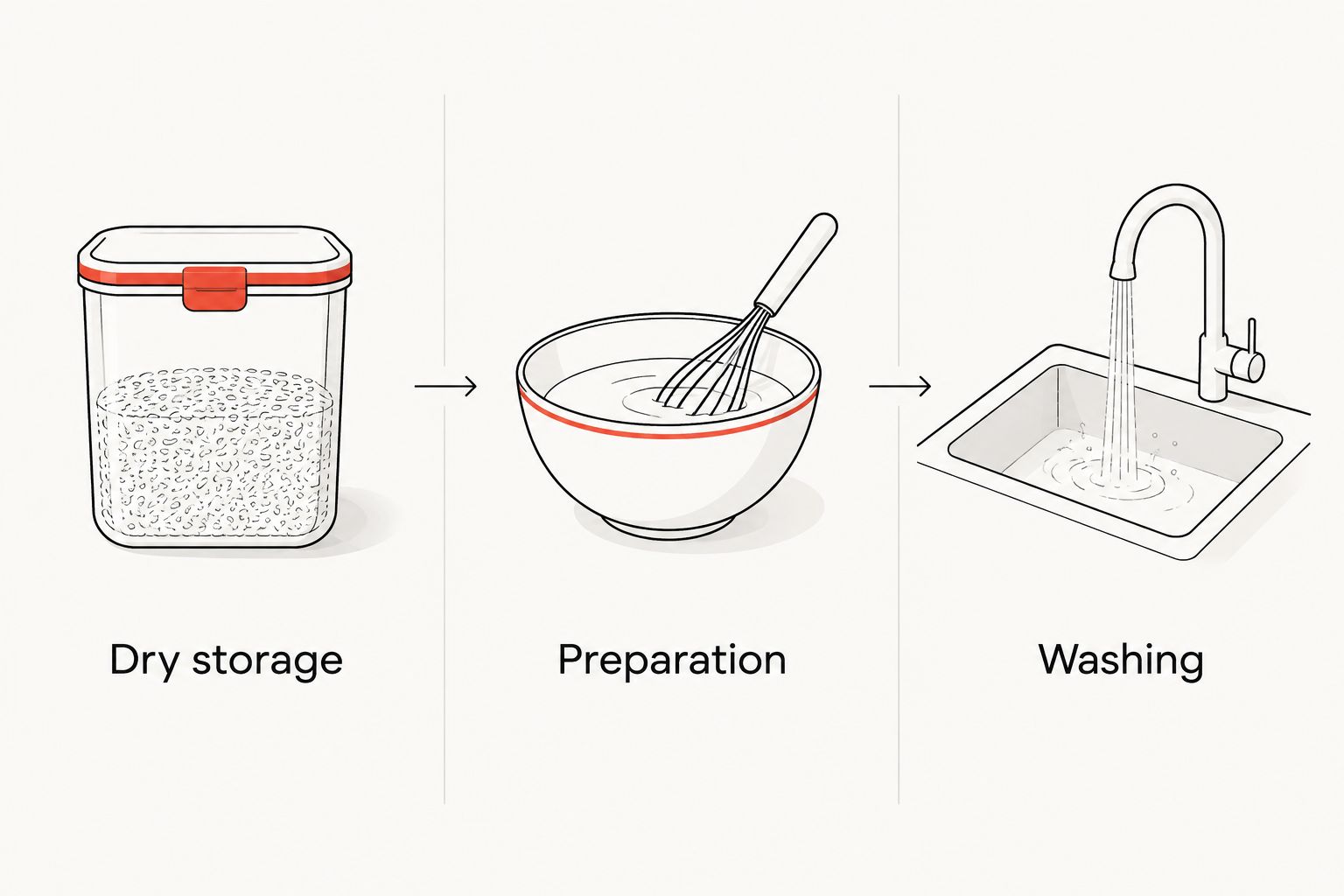
A home office can use the kitchen for preparation and washing while keeping the finished drink at the desk. There is no need to reproduce the entire kitchen routine beside the keyboard.
The matcha is the same in both choices
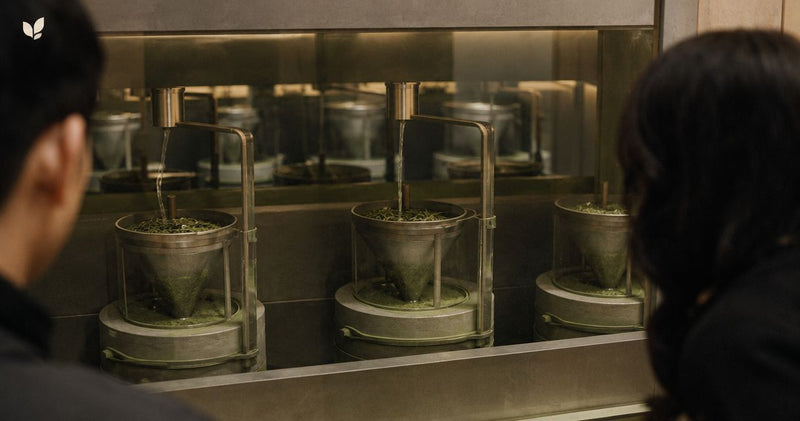
Uchi supplies Kaze no Shiro, a first-flush blend composed by the house tea master at Horii Shichimeien. The producer was founded in Uji, Japan, in 1879.
The blend draws first-harvest tencha from Kyoto, Nara and Shiga, weaving three cultivars: Okumidori, Yabukita and Sayamakaori. It is not a single-origin, single-estate or single-cultivar matcha.
The tea is shaded for 25 days before harvest and stone-milled at 40 grams an hour. These details describe the tea and its production; they do not change between Home and Complete.
For this 2026 comparison, the relevant distinction is equipment. Choose according to what is missing from the preparation space, not an assumption that Complete contains a different grade of matcha.
Blending also deserves a precise reading. Here, it is the house tea master's composition of leaves and cultivars—not evidence that the tea comes from one farm.
Keep freshness separate from convenience
A desk-side container is convenient only if its position is suitable. A sunny windowsill beside the monitor remains a sunny windowsill, even when the container looks at home there.
Close the Base after measuring. Leaving it open while answering a message or waiting for water adds exposure without helping preparation.
Keep the Spoon dry when handling powder. Do not return a damp utensil to the stored matcha, and keep the open container away from steam.
There is also a difference between recyclable packaging and a fully resolved material story. The Pod uses recyclable aluminium; that does not establish the local collection route. Packaging also includes a foam insert, which should not disappear from the account of materials.
These are modest distinctions, but they keep the choice accurate. The Base addresses storage. The tools address preparation. Neither removes the need for care.
How the choices are ordered
The order follows the amount of equipment already in place. Home comes first for an equipped kitchen near a desk; Complete follows for a new preparation area without the tools.
The criteria are freshness protection, existing equipment, preparation space, washing, handling and storage. No price comparison or performance score is needed to separate these two uses.
For office planning in 2026, the decisive check is physical: identify where the powder stays dry, where the drink is made and where the tools are cleaned. Then choose the contents that fill the actual gap.
Choose around the routine already in place
Choose Home if suitable preparation tools already exist. Choose Complete if they do not and there is somewhere to use, wash and dry them. Both include the same storage components and matcha.
If neither condition is settled, start with the room rather than the purchase. Confirm access to water, a stable preparation surface and clean storage for dry tools.
For a work desk itself, keep the arrangement restrained. The finished drink can belong beside the laptop even when the Bowl, Whisk and powder remain in the kitchen.
FAQ
Which should I choose for a work desk, Home or Complete?
Choose Home if suitable preparation tools already exist; choose Complete if they do not and a dedicated preparation space is available. Both include Base and Pod, so the difference is the accessories rather than the matcha.
Does Home include a Whisk?
Home includes Base and Pod only. Complete includes Base, Pod, Bowl, Spoon, Sieve and Whisk.
Does Complete contain different matcha from Home?
No. Both include a 40g Pod of Kaze no Shiro, the first-flush blend composed by the house tea master at Horii Shichimeien.
Can I prepare matcha directly at my desk?
Use a stable preparation surface away from papers and electronics. Keep the stored powder separate from water and steam, and confirm that used tools can be washed and dried nearby.
How many cups does a Pod contain?
A Pod contains 40g of matcha, about twenty cups. The number of preparations depends on how much powder is used each time.
Does the Base replace the Bowl?
No. The Base is an airtight stainless steel matcha canister, while the Bowl is a chawan used for preparation. Complete includes both; Home includes the Base but not the Bowl.
Where should I keep matcha in an office?
Keep matcha closed, dry and away from direct sunlight, heat and steam. A desk beside a sunny window or radiator is not a suitable storage position simply because it is convenient.
One last thing
The useful addition to a work desk can be an empty space. Keeping preparation in the kitchen leaves fewer wet objects beside electronics and gives the tools a clear route back to the sink.
For a 2026 home-office arrangement, decide what should stay off the desk as carefully as what belongs on it. Uchi Home and Complete answer different equipment needs; neither requires every object to sit beside the screen.