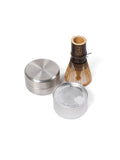
A 40g Pod makes about 20 servings at 2g each, or 13–40 complete servings across the 1–3g doses compared below. These 2026 matcha dosing benchmarks separate the amount of powder from the size of the drink, then show how Spoon, Sample and Pod measurements relate.
- 40g matcha how many servings: a Uchi Pod makes about 20 cups at 2g per cup.
- One leveled Spoon holds 1 gram; two leveled measures make a 2g dose.
- The 6g Sample provides two 3g servings, not two servings at the Pod’s 2g reference dose.
- Measure the powder, close the canister, then prepare the drink. Storage matters alongside serving count.
Matcha servings from 40g
The reference benchmark is 20 servings from 40g at 2g per serving. The table compares powder doses, not cup sizes. A larger drink does not automatically contain more matcha.
| Powder per serving | Leveled Spoon measures | Complete servings per Pod |
|---|---|---|
| 1g | 1 | 40 |
| 2g — reference | 2 | 20 |
| 3g | 3 | 13, with 1g remaining |
The 1g dose produces the highest count: 40 complete servings. The 3g dose produces the lowest: 13 complete servings, with 1g remaining. Neither is a quality ranking; each describes how quickly the same 40g is portioned.
Methodology: These 2026 calculations use Uchi’s stated 40g Pod content and 1g capacity per leveled Spoon. They assume accurate doses and no powder lost during handling; they do not measure individual scooping variation or establish a universal serving size.
Why this matters
A serving count only makes sense beside its dose. Twenty cups from 40g describes a 2g portion. It does not promise twenty drinks of any strength, made with any amount of powder.
The same distinction matters for freshness. Air and light affect stored matcha; measuring deliberately helps keep the canister open only for the preparation step that requires it. Take out the powder, close the container, then turn to the water and bowl.
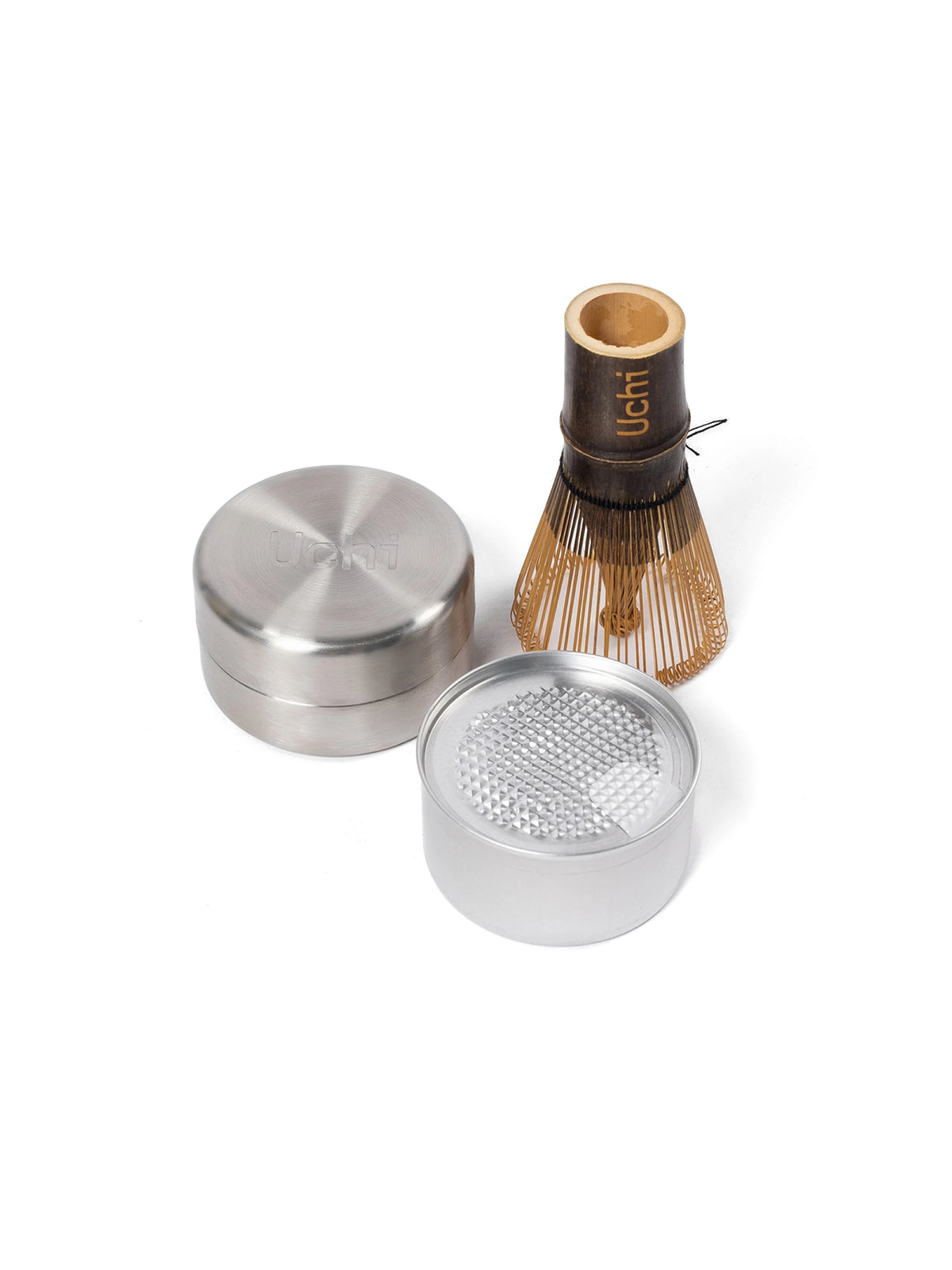
The Base is an airtight stainless steel canister that blocks light and is kept for life. It still needs sensible placement away from heat. A closed canister beside a hot appliance is not the same storage condition as a closed canister in a cool cupboard.
Uchi matcha suits home drinkers who want refillable storage and a repeatable measured dose. The limitation is equally concrete: the container does not choose the dose or measure the powder. That remains part of preparation.
Spoon, Sample and Pod: different kinds of measurement
Spoon, Sample and Pod are not three competing serving sizes. The Spoon measures powder. The Sample and Pod contain powder. Comparing them requires a common unit: grams.
One leveled Spoon holds 1 gram. The Sample contains 6g and is described as two servings. The Pod contains 40g and is described as about twenty cups. Those serving descriptions use different implied doses.
Format benchmarks
| Format | Stated amount | Serving reference |
|---|---|---|
| Spoon | 1g per leveled measure | A measuring unit |
| Sample | 6g total | Two servings at 3g each |
| Pod | 40g total | About twenty cups at 2g each |
The Pod contains the larger quantity, at 40g; the Sample contains 6g. The Spoon’s 1g figure describes one measurement, not the total content of a package. Treating all three numbers as serving sizes would mix unlike quantities.
Methodology: This 2026 comparison uses the stated product quantities and serving descriptions. The 3g Sample reference and 2g Pod reference are calculated by dividing content by stated servings; they are not evidence that every drink should use those amounts.
What the Sample’s two servings mean
Dividing 6g into two equal portions gives 3g per portion. At the Pod’s 2g reference dose, the same Sample instead makes three servings. Both calculations are correct because the denominator changes.
For a tasting comparison, keep the powder dose consistent. Comparing a 3g Sample drink with a 2g Pod drink introduces a preparation difference before considering the matcha itself. Keep the water quantity and preparation method consistent too.
What the Pod’s twenty cups mean
Forty grams divided into twenty equal portions gives 2g per portion. That is the practical reference for planning how many drinks a Pod supplies. Two leveled Spoon measures correspond to that dose.
The word “about” remains useful. Powder left on a measuring tool, an uneven measure or a spill changes the final count. The arithmetic is exact; daily handling is not a laboratory measurement.
How to use these benchmarks
Use the 2026 reference dose as a starting point for counting, not as a rule about taste. These actions keep the calculation connected to what actually happens at the counter.
- Use 2g when planning around twenty servings. Count two leveled Spoon measures per drink. Changing to three measures changes the expected yield to thirteen complete servings, with 1g remaining.
- Compare formats at the same dose. At 2g per drink, the 6g Sample gives three servings and the 40g Pod gives twenty. Package descriptions alone do not provide a like-for-like comparison.
- Separate dose from drink volume. Record the powder amount alongside the water or milk amount. A larger cup changes dilution unless the powder dose changes too.
- Keep serving count separate from storage life. Twenty portions describe quantity. They do not establish how long opened matcha retains its colour, aroma or taste.
Use a scale when the distinction matters
A leveled measure provides a defined starting point. A heaped measure does not have the same stated capacity. Scraping, packing or leaving a mound above the edge changes what is being measured.
A kitchen scale provides a separate check on the powder mass. Use a scale that can resolve the intended dose, and read its stated precision rather than assuming every display is equally useful for small quantities. Tare the receiving bowl before adding matcha.
The choice is practical. A Spoon removes a weighing step from daily preparation; a suitable scale checks the mass directly. Neither method removes the need to decide how much powder belongs in the drink.
A repeatable dosing sequence
The order matters because an open canister does not need to sit beside the entire preparation. Have the dry measuring tool and receiving bowl ready before opening it. Keep water preparation separate from powder storage.
Prepare dry tools
Begin with a dry Spoon and a dry receiving bowl or Sieve. A tool that has just been rinsed is not ready until it is dry. Keep the powder away from steam while measuring.
Measure the dose
For the 2g reference, take two leveled Spoon measures. Alternatively, tare a suitable scale and weigh 2g into the receiving vessel. Use the same method when comparing successive drinks.
Close the canister
Close the Base after removing the powder. There is no preparation advantage in leaving the remaining matcha exposed while water heats or the drink is whisked. Keep the storage step brief and distinct.
Prepare the drink
Sift the measured powder if needed, then add the liquid and whisk. Record any change to the powder dose separately from a change to the liquid quantity. Otherwise, it becomes difficult to identify which change altered the drink.
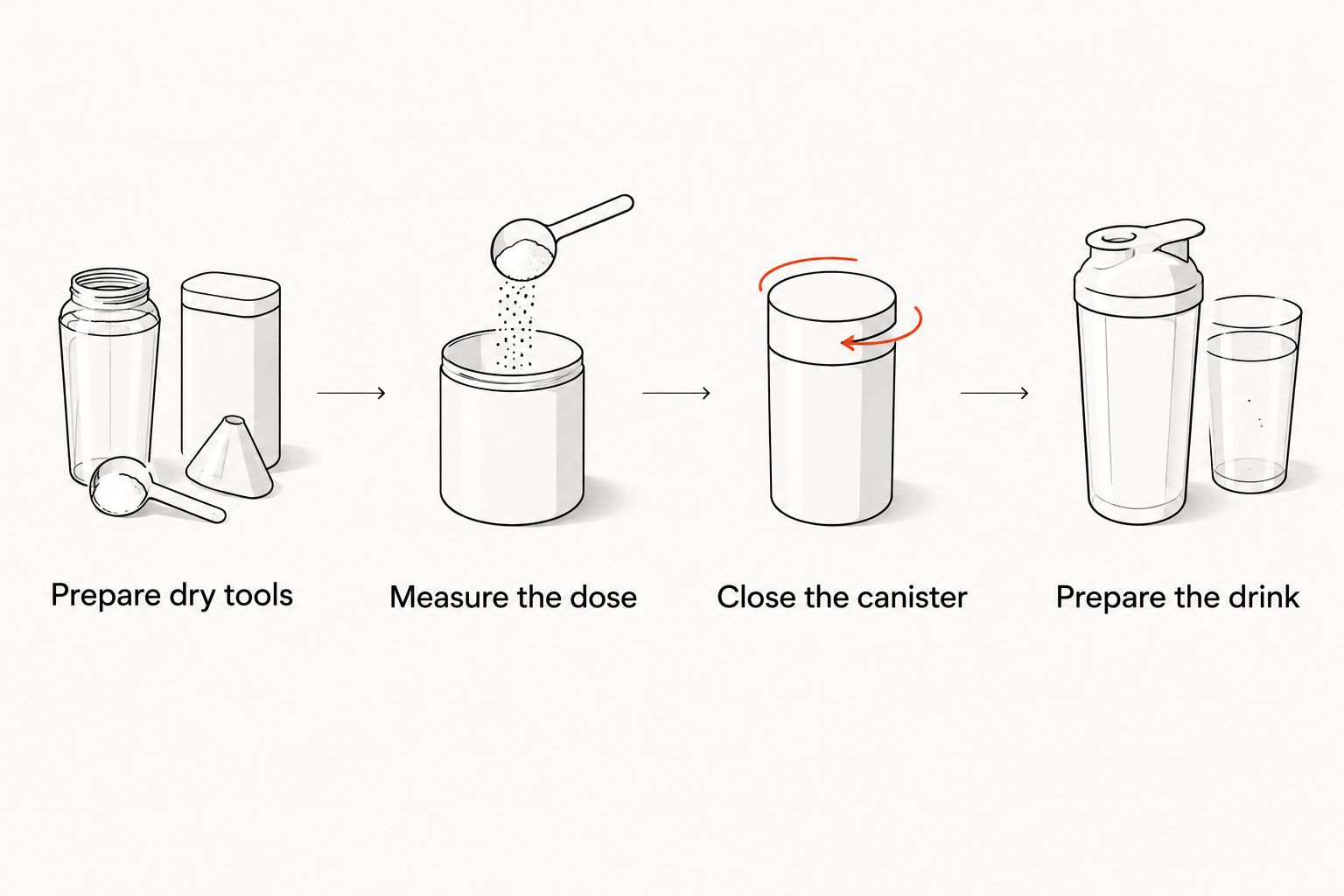
This sequence makes the serving calculation easier to follow without turning preparation into a counting exercise. The dose stays visible. The remaining powder stays closed away from the wet part of the process.
From servings to days at home
At 2g per drink, a 40g Pod supplies twenty drinks. For one drink each day, that is twenty days of portions. For two drinks each day, it is ten days of portions.
These are consumption calculations, not freshness deadlines. They assume the same dose every time and no handling loss. Skipping a day changes the calendar, not the amount of powder remaining.
A shared household
Count drinks rather than people. Two people making one 2g drink each use 4g together. A 40g Pod therefore supplies ten such shared occasions.
Different doses need separate counting. One 2g drink and one 3g drink use 5g together, so 40g supplies eight paired occasions. A single household average can conceal that difference if only the number of cups is recorded.
An occasional routine
For occasional preparation, start with the dose and frequency actually used. Do not read “twenty cups” as an instruction to finish the powder on a fixed schedule. The label describes an amount, not a calendar.
Freshness also depends on handling and storage. Keep the container closed between uses, protect it from light and place it away from heat. Serving arithmetic cannot compensate for an exposed container.
Choosing a format without confusing the dose
The relevant distinction is whether the reader wants a first taste, more matcha for an existing Base, or the storage and preparation objects together. A larger purchase does not require a larger serving.
| Format | Suited to | Boundary |
|---|---|---|
| Sample | A first taste | 6g for a short comparison |
| Pod | Existing Base owners | Matcha without the Base |
| Home | A first Base and Pod | No preparation tools included |
| Home + Whisk | Storage, matcha and a Whisk | No Bowl, Spoon or Sieve |
| Complete | Storage and preparation objects | Includes tools already owned by some readers |
Home contains Base and Pod. Home + Whisk adds the Whisk. Complete contains Base, Pod, Bowl, Spoon, Sieve and Whisk. Each includes one Pod, so each begins with the same 40g of matcha.
For someone who already owns suitable preparation tools, Home avoids adding those objects again. For someone who wants the named preparation tools together, Complete includes them. The trade-off concerns objects and routine, not a different serving yield.
The Sample suits a first taste but does not establish a storage routine. The Pod suits an existing Base owner but does not include the canister. Choose the format around what is missing, then choose the dose around the drink.
Keep the benchmark attached to the powder
The powder in the Pod is Kaze no Shiro, a first-flush blend composed by the house tea master at Horii Shichimeien. It draws first-harvest tencha from Kyoto, Nara and Shiga and weaves three cultivars: Okumidori, Yabukita and Sayamakaori.
The matcha is shaded for 25 days before harvest and stone-milled at 40 grams an hour. That milling rate describes production. It does not mean a serving contains 40g, or that one hour of milling defines a preparation method.
Keep those categories separate when reading matcha information. Harvest, cultivation and milling describe the powder’s production. Grams per drink describe preparation. Net content divided by that dose describes the serving count.
FAQ
How many servings does 40g of matcha make?
Forty grams makes twenty servings at 2g each. At 1g each it makes forty servings; at 3g each it makes thirteen complete servings with 1g remaining.
How many Spoon measures make a 2g serving?
Two leveled Spoon measures make a 2g serving. One leveled Uchi Spoon holds 1 gram; a heaped measure does not have that stated capacity.
Why does the Sample say two servings while the Pod says twenty?
The descriptions imply different powder doses: 3g for each of the Sample’s two servings and 2g for each of the Pod’s twenty cups. Compare both at the same dose when calculating yield.
Can a 6g Sample make three drinks?
A 6g Sample makes three drinks when each contains 2g of matcha. Its stated two-serving description corresponds to 3g per drink.
Does a larger latte always need more matcha powder?
A larger latte does not automatically require a larger powder dose. Keeping the powder fixed while adding more milk changes dilution; increasing the powder changes the serving count.
How long does a 40g Pod last at one drink a day?
A 40g Pod supplies twenty days of portions at one 2g drink each day. This is a quantity calculation, not a freshness guarantee or storage deadline.
Do Home and Complete contain different amounts of matcha in 2026?
Home and Complete each include one 40g Pod. Complete adds Bowl, Spoon, Sieve and Whisk to the Base and Pod included in Home; the powder quantity stays the same.
One last thing
Thirteen 3g servings leave 1g from a 40g Pod. That remainder is not a fourteenth 3g serving. Count complete portions honestly, then measure whatever remains rather than assuming the last drink matches the others.
For a repeatable 2026 home routine, keep the dose visible and the canister closed. The useful benchmark is not the largest possible cup count. It is the count that corresponds to the drink actually being made.