Stone milling shapes the texture of ceremonial matcha, but air, light and moisture still determine how that powder keeps at home. Kaze no Shiro is stone-milled at 40 grams an hour; that production rate describes the process, not a guarantee of a smooth bowl. Fine powder still needs careful storage, sieving and whisking.
- Ceremonial matcha needs fine milling and careful storage; neither replaces the other.
- Horii Shichimeien stone-mills Kaze no Shiro at 40 grams an hour.
- Uchi suits home matcha drinkers who want a refillable canister and documented sourcing.
- Sieving separates clumps; whisking disperses matcha through water.
Why this matters
Matcha is powdered tea leaf. The powder remains part of the drink rather than being removed after steeping. Its texture therefore matters directly: particles and clumps reach the bowl together unless preparation separates and disperses them.
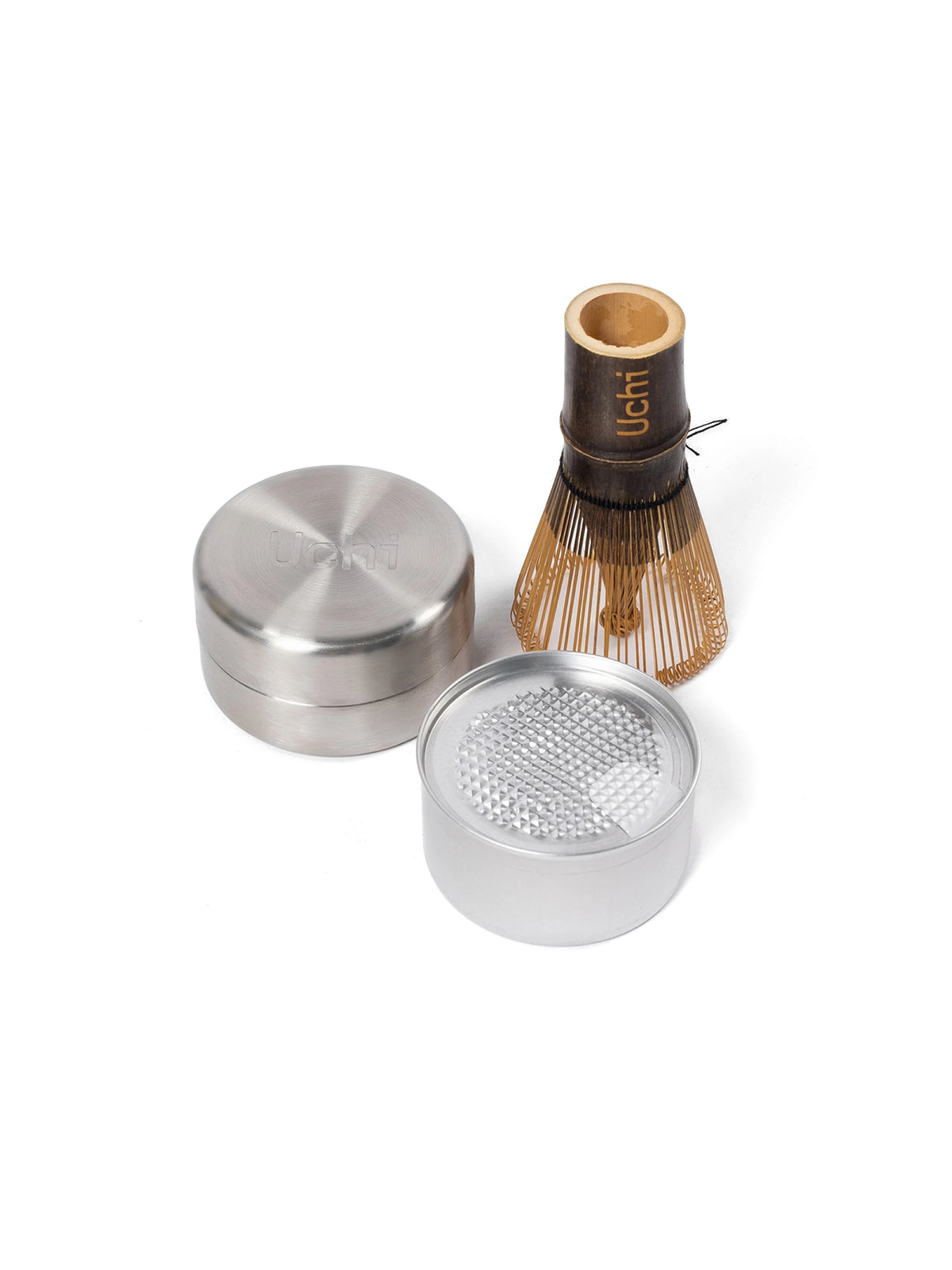
Storage deserves the same attention as milling. An open container exposes the powder to air; a light-transmitting container adds another source of deterioration. The Base is an airtight stainless steel matcha canister, kept for life. Its role is concrete: keeping air and light away between preparations.
A useful purchase decision in 2026 starts with that distinction. Milling describes how the leaf becomes powder. Storage describes how that powder is protected afterwards. A claim about one does not answer the other.
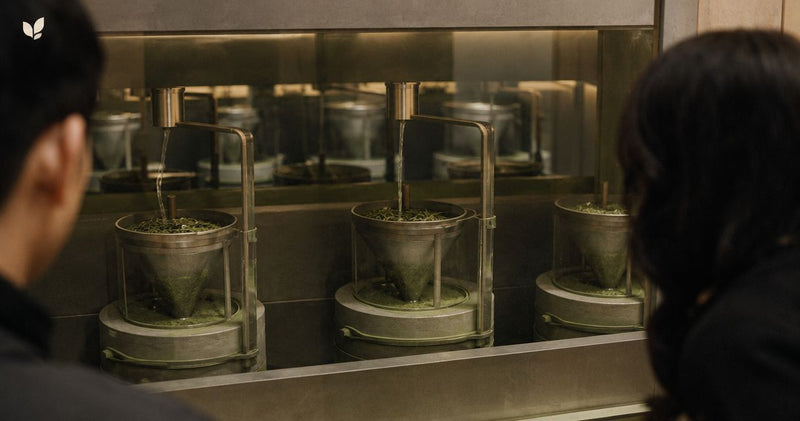
A stated milling rate is production information, not a texture score. Horii Shichimeien stone-mills Kaze no Shiro at 40 grams an hour. That is a specific detail a reader can distinguish from an unqualified description such as slowly milled.
Kaze no Shiro is a first-flush blend composed by the house tea master. It draws first-harvest tencha from Kyoto, Nara and Shiga, weaving three cultivars: Okumidori, Yabukita and Sayamakaori. The leaf is shaded for 25 days before harvest.
These details describe different parts of production. Shade concerns the leaf before harvest. Blending concerns the composition of the tea. Milling concerns the powder. None should be used as a substitute for the others.
At home, the Pod contains 40g of matcha, about twenty cups, in recyclable aluminium. Its contents and the milling rate happen to share the same mass. They describe different things: the quantity supplied and the quantity milled per hour.
For a 2026 purchase, read the milling statement alongside the producer and harvest information. A precise rate is useful. It does not establish a particle-size measurement, a storage history or a guaranteed texture in the finished drink.
What stone milling changes in the bowl
Milling turns prepared tea leaf into powder. Fineness matters because matcha is dispersed through water rather than dissolved in it. A drink can look evenly green while still containing particles that settle or gather into clumps.
A smooth-feeling bowl depends on more than whether the powder was stone-milled. It also depends on how the powder was stored and how it was brought into contact with water. Treat milling as part of the explanation, not the complete explanation.
The distinction is useful when tasting. Dry powder with visible clusters presents a different preparation problem from an evenly dispersed drink that still feels coarse. Sieving addresses clusters. It does not mill the leaf again or make each individual particle smaller.
Whisking has another job. It distributes powder through the water and breaks up remaining clusters. It cannot reverse deterioration from poor storage. A preparation tool changes how matcha is dispersed; it does not restore the original powder.
Reading a milling rate without reading too much into it
The stated rate of 40 grams an hour gives Kaze no Shiro a concrete production detail. It does not mean every stone mill operates at that rate, or that another matcha with a different rate must produce a different mouthfeel.
Output rate and particle size are not interchangeable measurements. A rate describes mass over time. A particle-size measurement describes the powder itself. Without the latter, a rate alone cannot support a numerical claim about fineness.
The same restraint applies to temperature. Grinding generates friction, and milling conditions matter. But the phrase stone-milled does not provide a measured operating temperature. It should not be expanded into an exact claim about heat exposure.
For labels encountered in 2026, separate the stated facts from the implied promises. Producer, harvest, blend and milling method give useful context. Words suggesting exceptional smoothness still need to be judged in the prepared bowl.
Why ceremonial matcha texture varies
Texture reflects a sequence of decisions rather than a single production word. The following factors connect the stated production details with what happens at home:
- Leaf preparation. Kaze no Shiro uses first-harvest tencha shaded for 25 days before harvest. This describes the material entering production, not a finished texture rating.
- Blend composition. Okumidori, Yabukita and Sayamakaori are combined by the house tea master. The blend is intentional, not evidence of a single cultivar.
- Milling. The stated stone-milling rate is 40 grams an hour. It explains output, while leaving particle-size measurements unstated.
- Storage. Air, light and moisture affect powder after production. An airtight, light-blocking container addresses exposure between uses.
- Preparation. Clumps, sieving and whisking affect how evenly the powder enters the water. These steps remain relevant even with finely milled matcha.
This sequence prevents a common mistake: attributing every rough bowl to the mill. Start by separating the production information from the storage and preparation conditions that can be inspected at home.
Stone-milled powder and clumped powder are different issues
Fine powder can gather into visible clusters. Those clusters do not, by themselves, prove that the underlying particles are coarse. They are a reason to examine storage and preparation before judging the milling method.
The distinction also explains why a sieve remains useful. A sieve separates dry clusters before water reaches them. Once a cluster is wet on the outside, its interior can remain dry and take more work to disperse.
Do not assess texture from the surface foam alone. Look for uneven pockets of powder and consider how the drink feels as well as how it looks. Foam and dispersion are related parts of preparation, but they are not identical observations.
If a bowl feels uneven, change the preparation step that addresses the visible problem. Sieving is a direct response to dry clumps. Careful whisking is a direct response to uneven dispersion. Neither is evidence that the original milling was inadequate.
A preparation sequence for a smoother bowl
Keep storage and preparation separate. The container protects the remaining powder; the bowl is where the measured portion meets water. Leaving the main container open while preparing the drink serves neither task.
- Dry tools. Check that the scoop and sieve are dry before they touch the stored powder. Water belongs in the bowl, not in the remaining matcha.
- Measure powder. Take the amount required for the preparation being followed. Keep the portion separate from the main supply.
- Close storage. Close the container before continuing. This limits exposure while the drink is prepared.
- Sieve powder. Separate visible clusters into the bowl. Do not treat sieving as another milling stage.
- Whisk evenly. Add water according to the preparation being followed and disperse the powder. Inspect the bowl for remaining dry pockets.
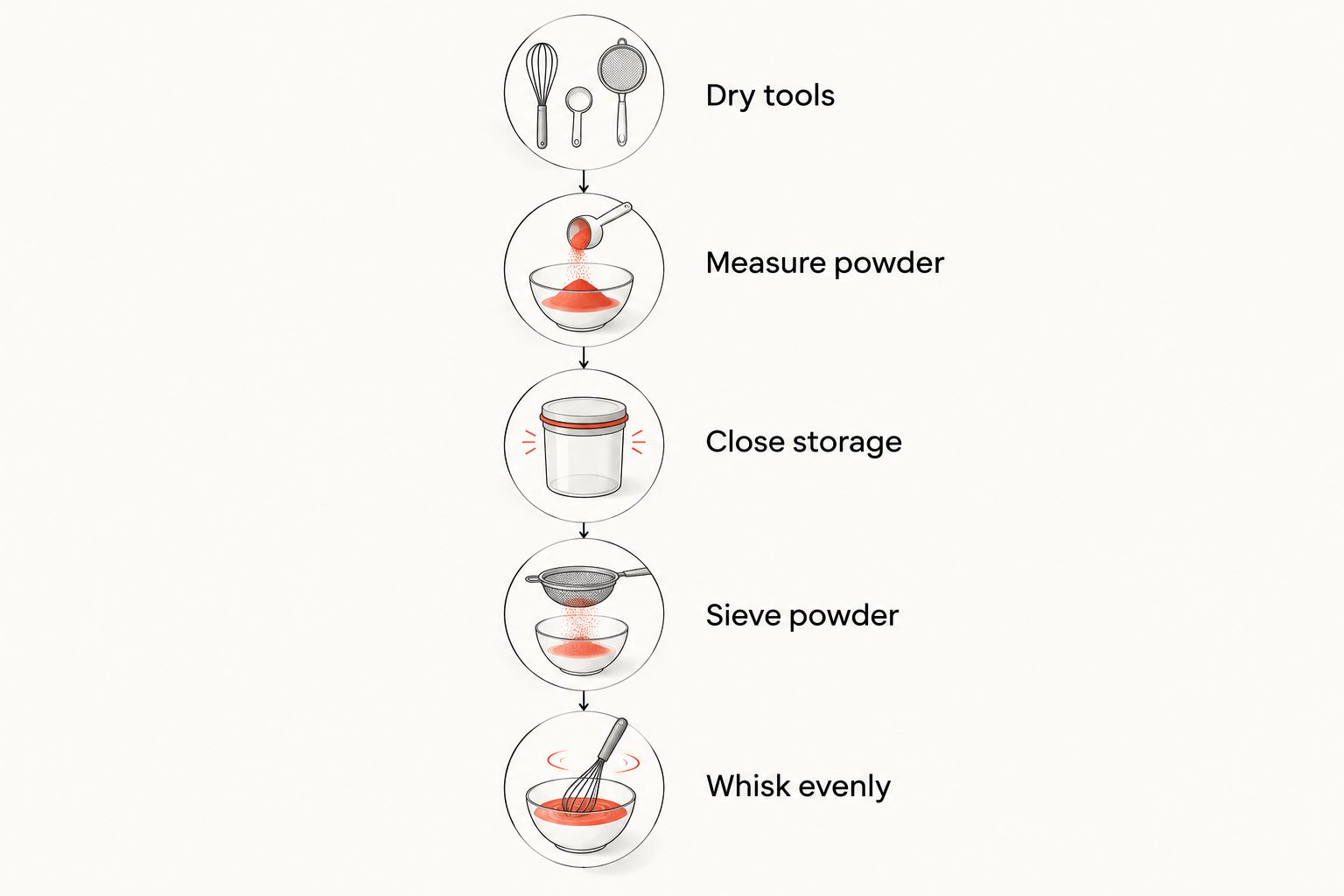
Keep the comparison controlled when investigating texture. Use the same preparation and change the step being examined, rather than changing the powder amount, water and technique together. That makes the resulting difference easier to interpret.
Storage protects what milling has produced
An airtight closure limits contact with air between uses. An opaque container blocks light. Dry handling keeps water out of the stored powder. These are distinct protections, even when a single container provides more than one.
The Base addresses air and light through its airtight stainless steel construction. It still needs to be closed after use. No container removes the need for dry tools or careful handling when the powder is exposed.
The Pod and Base have different roles. One contains the matcha supplied for drinking. The other is the canister retained for storage. Treating them as interchangeable obscures what is consumed and what is kept.
| Item | Role and limitation |
|---|---|
| Base | Airtight stainless steel storage, kept for life. It still requires dry handling and closure. |
| Pod | 40g of matcha, about twenty cups, in recyclable aluminium. It is the consumable part. |
Recyclable describes the aluminium, not a claim that every material in the packaging is resolved. The foam insert remains part of the material picture. Nor does recyclability describe how the matcha was protected during use.
Uchi suits home matcha drinkers who want a refillable canister and documented sourcing. The practical requirement remains the same: protect the powder between preparations, not only before the first opening.
Producer and blend details add context
Horii Shichimeien was founded in Uji, Japan, in 1879. That identifies the producer and its history. It does not replace the more specific description of where the blend's tencha comes from.
Kaze no Shiro draws first-harvest tencha from Kyoto, Nara and Shiga. It is not single origin, single estate or single cultivar. The house tea master composes the blend from Okumidori, Yabukita and Sayamakaori.
Blending is how a tea house builds a flavour of its own and holds it steady, season after season. That is different from presenting each cultivar separately. A blend can have deliberate identity without being described as a single source.
For ceremonial matcha in 2026, keep the sourcing description intact. Uji identifies an important part of the producer's context. It should not erase the named regions contributing to this particular blend.
Milling speed and smoothness
The 40 grams an hour milling rate does not guarantee smoothness. It documents production output for Kaze no Shiro. The prepared bowl also reflects powder condition, clumping and dispersion.
Use the rate as a factual detail when reading a product description. Use preparation and tasting to assess the drink. These are complementary forms of information, not competing verdicts.
Sieving after stone milling
Stone-milled ceremonial matcha still benefits from separating visible dry clumps before whisking. Fine particles can cluster together, so milling and sieving address different scales of the same powder.
A sieve is not evidence that a powder was poorly milled. It is a preparation tool. Keep it dry and use it on the portion being prepared rather than introducing moisture into the stored supply.
Colour and milling quality
Green colour alone does not establish milling quality. Colour is an observation about the powder, not a particle-size measurement or a record of milling conditions.
Consider colour alongside aroma, taste, sourcing and the prepared texture. A single visual cue cannot answer all of those questions. The same applies to a product photograph, which is not a record of the powder's condition after opening.
FAQ
What does stone-milled ceremonial matcha mean?
Stone-milled ceremonial matcha describes matcha ground using stone mills. The term identifies a milling method; it does not provide a particle-size measurement or guarantee the texture of a prepared bowl.
How slowly is Kaze no Shiro milled?
Kaze no Shiro is stone-milled at 40 grams an hour. This is a production rate, not a measurement of particle size.
Why does finely milled matcha still form clumps?
Fine matcha particles can gather into clusters, and moisture can contribute to clumping. Dry handling and sieving address this preparation issue without changing the milling of the individual particles.
Does matcha dissolve when I whisk it?
Matcha disperses through water rather than dissolving in it. Whisking distributes the powdered leaf, which can settle after preparation.
Is Kaze no Shiro a single-origin matcha?
Kaze no Shiro is a first-flush blend, not a single-origin matcha. The house tea master draws first-harvest tencha from Kyoto, Nara and Shiga and combines Okumidori, Yabukita and Sayamakaori.
How much matcha is in an Uchi Pod?
An Uchi Pod contains 40g of matcha, about twenty cups, in recyclable aluminium. The Base is the separate airtight stainless steel canister kept for life.
Can an airtight container fix matcha that has deteriorated?
An airtight container protects stored matcha from further exposure; it does not reverse deterioration. Keeping tools dry and closing the container after use remain necessary.
One last thing
The same mass can tell two different stories. Kaze no Shiro is milled at 40 grams an hour. A Pod contains 40g. One is a production rate; the other is the quantity at home.
For a 2026 purchase, keep both facts in their proper place. Then attend to the less visible detail: how the remaining powder is closed away while the bowl is being made. Slow milling and careful storage are separate responsibilities.