Ceremonial matcha is not a complete quality specification. Read beyond the grade name to identify the producer, harvest, blend and packaging; then check how the matcha will be protected from air and light after opening. This 2026 guide separates useful label details from language that leaves those questions unanswered.
- Ceremonial matcha needs more than a grade name: look for producer, harvest and storage details.
- Uchi names Horii Shichimeien as the producer of Kaze no Shiro, a first-flush blend.
- First harvest describes the leaves; blending describes how the tea is composed. Neither replaces the other.
- Airtight, opaque storage protects matcha from air and light after opening.
Why this matters
Matcha is finely ground tea. Its condition changes with exposure to air, light, heat and moisture. A detailed origin story does not remove the need for careful storage.
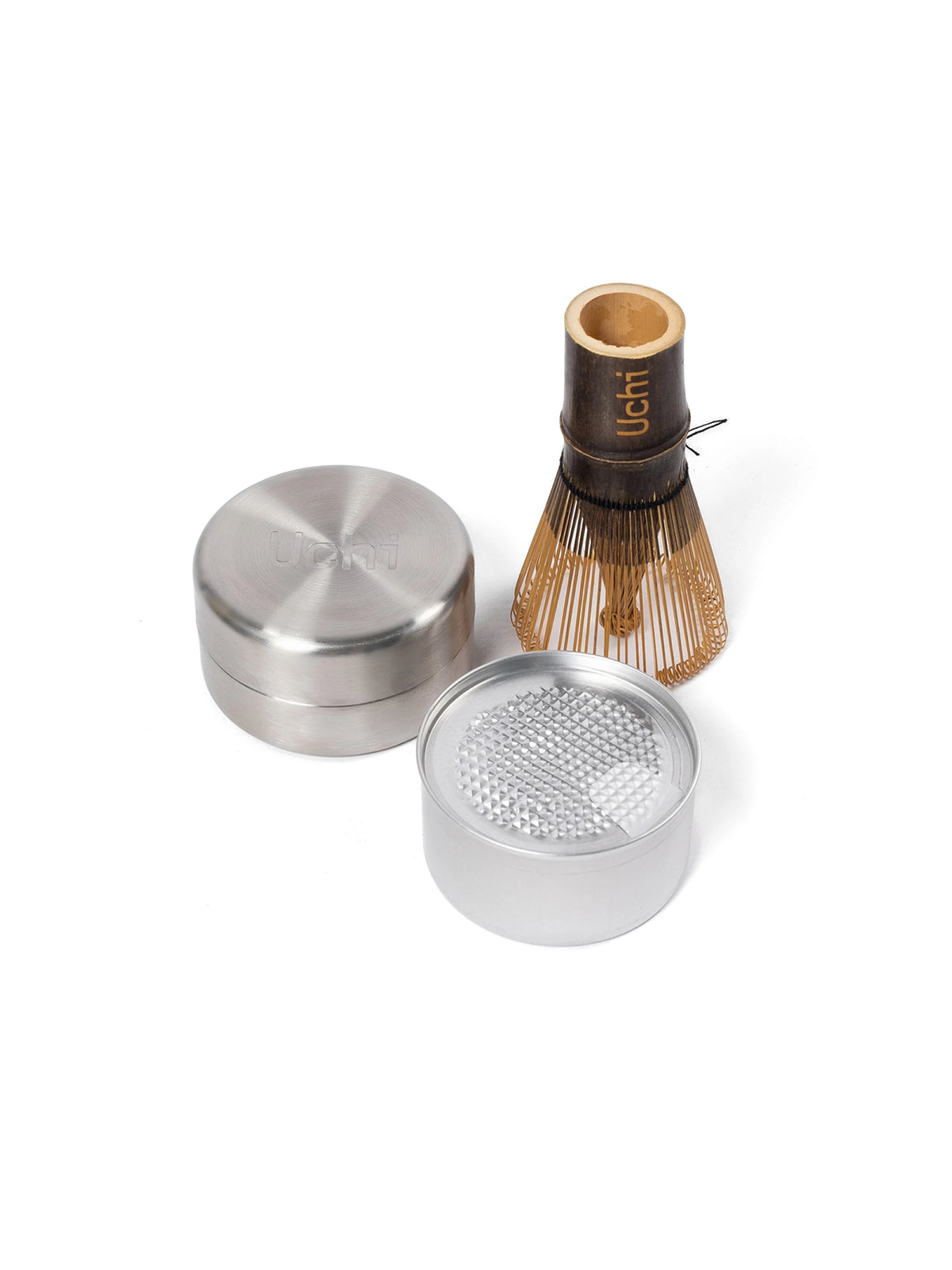
The package matters twice: before opening and during daily use. Uchi’s Base is an airtight stainless steel matcha canister, kept for life. The concrete purpose is to protect the matcha between preparations, rather than leave it exposed on the counter.
For a home purchase in 2026, start with information that remains useful after the first bowl. A named producer helps identify the tea. Harvest and blend details explain its composition. Packaging tells you how to look after it.
None of those details should disappear behind the word ceremonial.
Read a ceremonial matcha label in a fixed order. Begin with who made the tea, then examine the leaves and their composition. Finish with the package and the storage instructions.
- Identify the producer. Look for a named tea house or producer, not only the name of the retailer.
- Read the harvest description. First harvest or first flush is useful information. It does not, by itself, describe every part of production.
- Identify the composition. Check whether the tea is a blend and whether its regions or cultivars are named.
- Separate production from packing. Harvest, milling and packing are different events. A date needs to state which event it records.
- Check storage after opening. Look for a closure that limits air exposure and a container that excludes light.
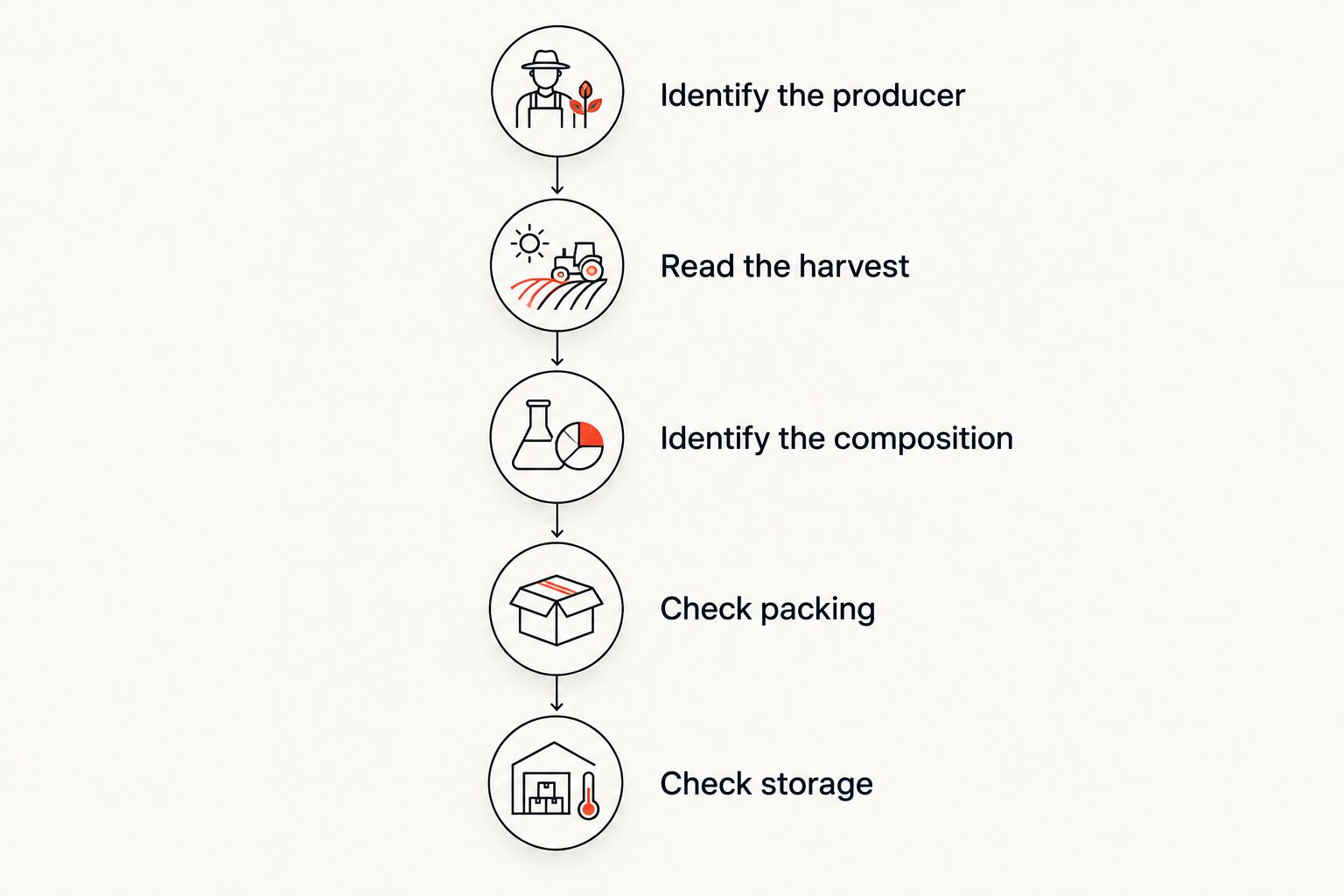
These checks answer different questions. A producer name establishes identity, not the current condition of an opened package. A packing date provides timing, not proof of how the tea was stored afterwards.
A useful 2026 label review keeps those distinctions intact. Do not ask one word or one date to stand in for the whole product.
| Label detail | Useful evidence | Its limit |
|---|---|---|
| Ceremonial | Intended positioning | Not a full specification |
| Named producer | Who made the tea | Not its storage history |
| First harvest | Harvest description | Not blend composition |
| Named cultivars | Leaves in the blend | Not freshness on opening |
| Packing date | When tea was packed | Not the harvest date |
| Airtight container | Storage mechanism | Still needs careful use |
Producer: a name that can be followed
A producer name gives the tea an identity beyond the shop selling it. It allows the description to connect to a particular tea house, rather than rely entirely on broad claims about Japanese origin.
Uchi’s matcha is Kaze no Shiro from Horii Shichimeien, founded in Uji, Japan, in 1879. Kaze no Shiro is a first-flush blend composed by the house tea master, drawing first-harvest tencha from Kyoto, Nara and Shiga and weaving three cultivars: Okumidori, Yabukita and Sayamakaori.
That description carries several distinct facts. It names the producer, the tea, the harvest, the growing regions and the cultivars. Each contributes information that ceremonial alone does not provide.
A named producer is a starting point, not a substitute for the rest of the label. Read its name alongside the composition and packaging details.
Also distinguish the producer’s location from the origin of every leaf. A house based in Uji can compose a blend using tencha from more than one region. Calling such a tea single origin would erase information rather than clarify it.
Harvest: first flush describes the leaves
First flush refers to the first harvest. It is a meaningful production detail, but it is not a complete description of the finished matcha.
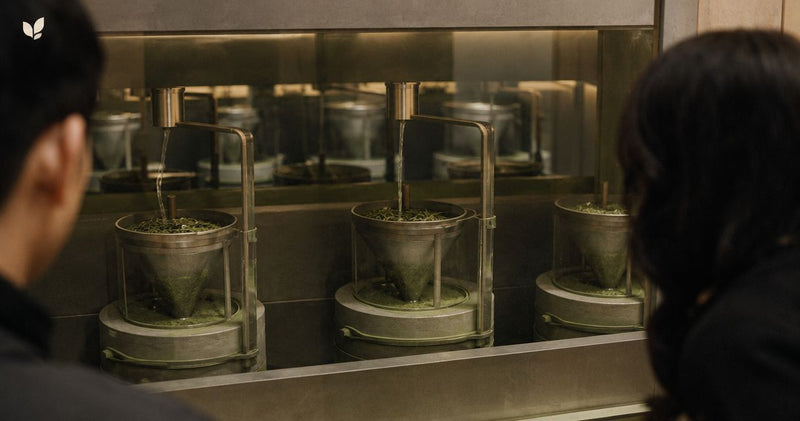
Kaze no Shiro uses first-harvest tencha. The tea is shaded for 25 days before harvest and stone-milled at 40 grams an hour. Those figures describe specific parts of its production, not a promised experience in every bowl.
Harvest information is useful because it identifies which crop is being discussed. Shading and milling details add context. They should remain separate facts rather than become a single, vague claim of quality.
First harvest and fresh after opening are different statements. The former describes the leaves. The latter depends on the tea’s subsequent handling and storage.
For a 2026 purchase, read any year on the package together with its label. A harvest year, packing year and purchase year describe different points in the tea’s life. None should be silently substituted for another.
Blend: composition rather than a compromise
A blend combines selected teas into a deliberate composition. It is not evidence that the producer has taken a shortcut.
In Uji, blending is how a house builds a flavour of its own and holds it steady, season after season. Kaze no Shiro brings together Okumidori, Yabukita and Sayamakaori, with first-harvest tencha from Kyoto, Nara and Shiga.
The useful question is whether that composition is described accurately. Single cultivar, single estate and single origin each make a different claim. None describes this blend.
A named blend gives you something specific to recognise when choosing again. Its limitation is equally clear: the name cannot tell you how an individual package has been handled.
Read cultivar information as composition, not as a ranking. A list of cultivars tells you what the producer has selected. It does not replace tasting the tea in the way you normally prepare it.
Packing: identify the event behind the date
A date is useful only when its meaning is clear. Harvesting the leaves, milling tencha into matcha and packing the powder are separate events.
If a package gives a packing date, read it as a packing date. Do not treat it as the day the leaves were harvested or the powder was milled. The same discipline applies to a best-before date: it is not a production date.
Match the date to the event before drawing a conclusion about freshness. If the wording is unclear, ask the seller what the date records.
Packing information also includes the material and closure. An opaque package excludes light. An airtight closure limits air exchange when closed. Those are concrete functions, not decorative details.
The limitation is daily use. Opening a container exposes its contents to the surrounding air, and leaving it open extends that exposure. A good closure only performs its function when it is closed.
Look for instructions that make sense in an ordinary kitchen. The matcha should have a clear place to live between preparations, away from direct light, heat and moisture.
Storage: protect the tea after opening
Freshness is not settled at checkout. It becomes a small sequence repeated whenever matcha is prepared.
Keep the storage container closed while arranging the bowl and tools. Open it to measure the powder, then close it before adding water elsewhere. Use dry utensils when handling the stored matcha.
This separates storage from preparation. Steam, splashes and wet tools belong near the bowl, not inside the matcha container. The distinction is simple and useful.
An airtight, opaque container addresses air and light. It does not remove the need to choose a sensible storage location. A spot beside a hot appliance or in direct sunlight defeats part of that care.
Colour and taste are observations, not certificates. They help you notice changes in a tea you know, but they do not independently prove a harvest, cultivar or producer.
Read the label for identity. Use careful storage to preserve the tea’s condition. Both matter; neither replaces the other.
Why ceremonial matcha descriptions vary
Labels emphasise different parts of the same product. The differences become easier to read when each claim has a defined role.
- Producer detail. A named tea house gives more specific information than a retailer name alone.
- Harvest detail. First flush identifies the crop, while an undifferentiated grade name does not.
- Blend detail. Regions and cultivars describe composition without implying that one origin is required.
- Processing detail. Shading and milling figures explain production stages when they are explicitly supplied.
- Packing detail. Materials, closures and clearly labelled dates explain how the tea is contained.
- Storage detail. Instructions address what happens after the package is opened at home.
These are not interchangeable measures. A label can be precise about origin and vague about packing. Another can explain the container while saying little about the leaves.
The useful description connects the tea and its care. It gives enough information to understand both.
A home choice built around storage
Uchi suits home matcha drinkers who want named sourcing and a keep-for-life storage object. The tea and the container have separate roles: the Pod is the matcha itself, while the Base protects it between preparations.
The Pod contains 40g of matcha, about twenty cups, in recyclable aluminium. Recyclable describes the material; it does not mean the aluminium is recycled, nor does it settle the disposal of every packaging component. The foam insert remains an unresolved material.
Home contains Base + Pod. Complete contains Base + Pod + Bowl + Spoon + Sieve + Whisk. The distinction is the preparation tools, not a different description of the tea.
| Choice | Suits | Limitation |
|---|---|---|
| Home | Existing preparation tools | Adds no preparation tools |
| Complete | Storage and tools together | Includes tools already owned |
Home is the straightforward choice when suitable tools are already in use. Complete brings the storage object and preparation tools together. Neither changes the need to close the Base and keep moisture away from the stored matcha.
The Spoon holds 1 gram when levelled. The Whisk is a bamboo chasen with 120 prongs. These are useful specifications because they describe actual objects, not an abstract grade.
FAQ
What does ceremonial matcha mean on a label?
Ceremonial matcha is a grade description, not a complete quality specification. Read it alongside the producer, harvest, blend and packaging details rather than treating the word as sufficient evidence.
Does first-flush matcha mean single-origin matcha?
First-flush matcha does not mean single-origin matcha. First flush describes the harvest; a blend can contain first-harvest tencha from several regions.
Who produces Uchi’s ceremonial matcha?
Horii Shichimeien produces Uchi’s ceremonial matcha, Kaze no Shiro. The house was founded in Uji, Japan, in 1879, and the tea is a first-flush blend composed by its tea master.
Which cultivars are in Kaze no Shiro?
Kaze no Shiro combines Okumidori, Yabukita and Sayamakaori. The blend draws first-harvest tencha from Kyoto, Nara and Shiga; it is not single cultivar or single origin.
Is a matcha packing date the same as a harvest date?
A matcha packing date is not a harvest date. Harvesting, milling and packing are separate events, so the date needs to identify which event it records.
How should ceremonial matcha be stored after opening?
Store ceremonial matcha in an airtight, opaque container away from heat and moisture. Close it after measuring the powder and keep wet utensils away from the stored tea.
What is the difference between Uchi Home and Complete?
Uchi Home contains Base + Pod; Complete contains Base + Pod + Bowl + Spoon + Sieve + Whisk. Choose according to the preparation tools already at home, rather than expecting a different tea.
One last thing
Close the matcha before preparing the bowl. It is a small change, but it keeps the stored powder separate from water, steam and the rest of the preparation.
For a 2026 buying decision, give every appealing label word a concrete follow-up. Ceremonial needs production details. First harvest needs accurate composition. A storage claim needs a material, a closure and a habit that keeps the container closed.
The most useful label is not the one with the most adjectives. It is the one that tells you what the tea is and how to care for it.