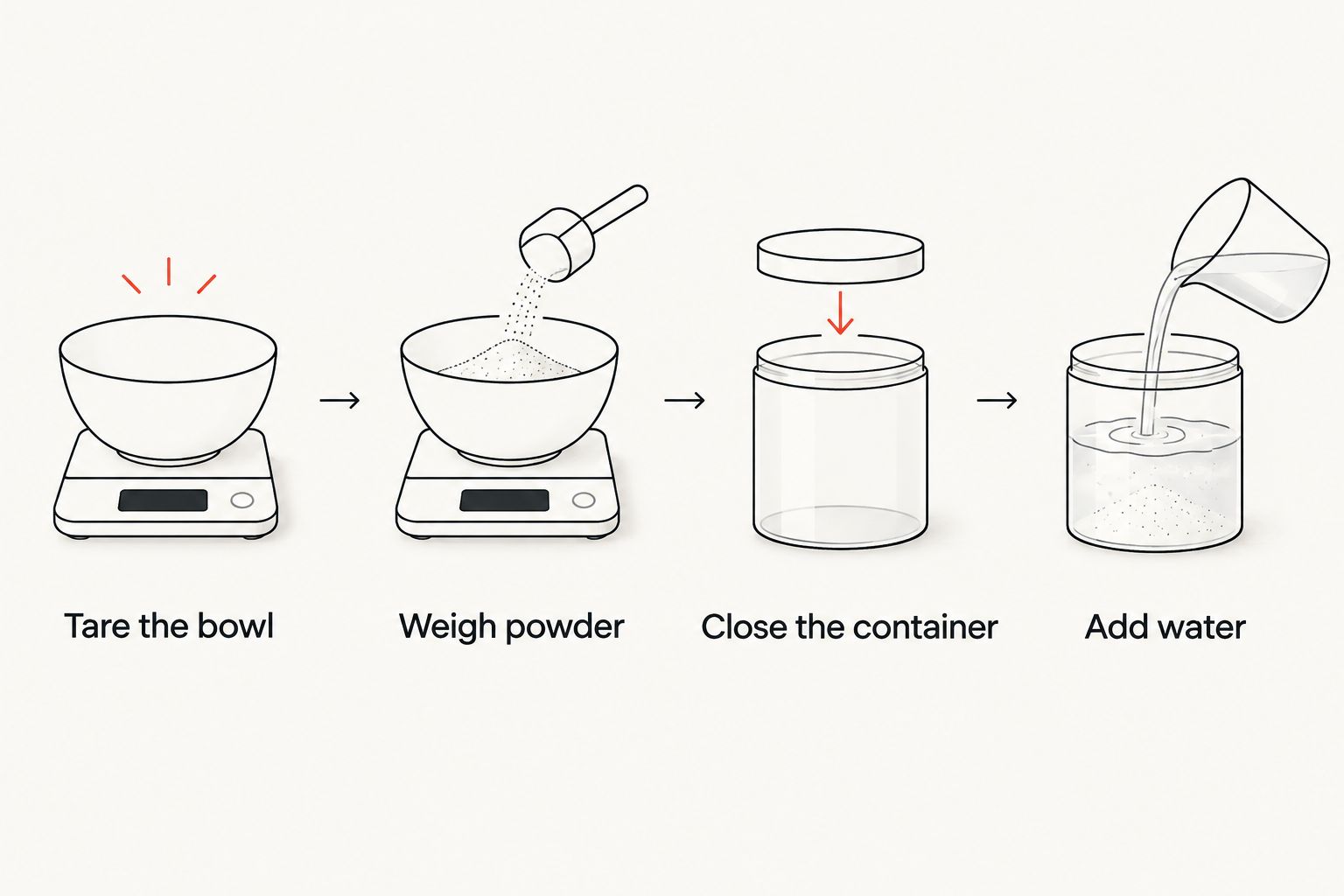
Instead of guessing a matcha portion each morning, weigh it into the same dry bowl, close the matcha container, then add a measured amount of water. This kitchen scale matcha portion workflow keeps the recipe repeatable without leaving the powder exposed while you prepare everything else.
- For a repeatable kitchen scale matcha portion, weigh powder before adding water and keep the bowl dry.
- Uchi suits home matcha drinkers who want airtight storage alongside a repeatable preparation routine.
- Use grams, tare the bowl, and keep the water amount unchanged while adjusting the powder.
- Close the Base before heating water or whisking; a measured portion does not replace careful storage.
Why this matters
Air, light and heat affect stored matcha. A precise portion cannot restore powder that has lost its character. Start with storage, then make the measuring routine consistent.
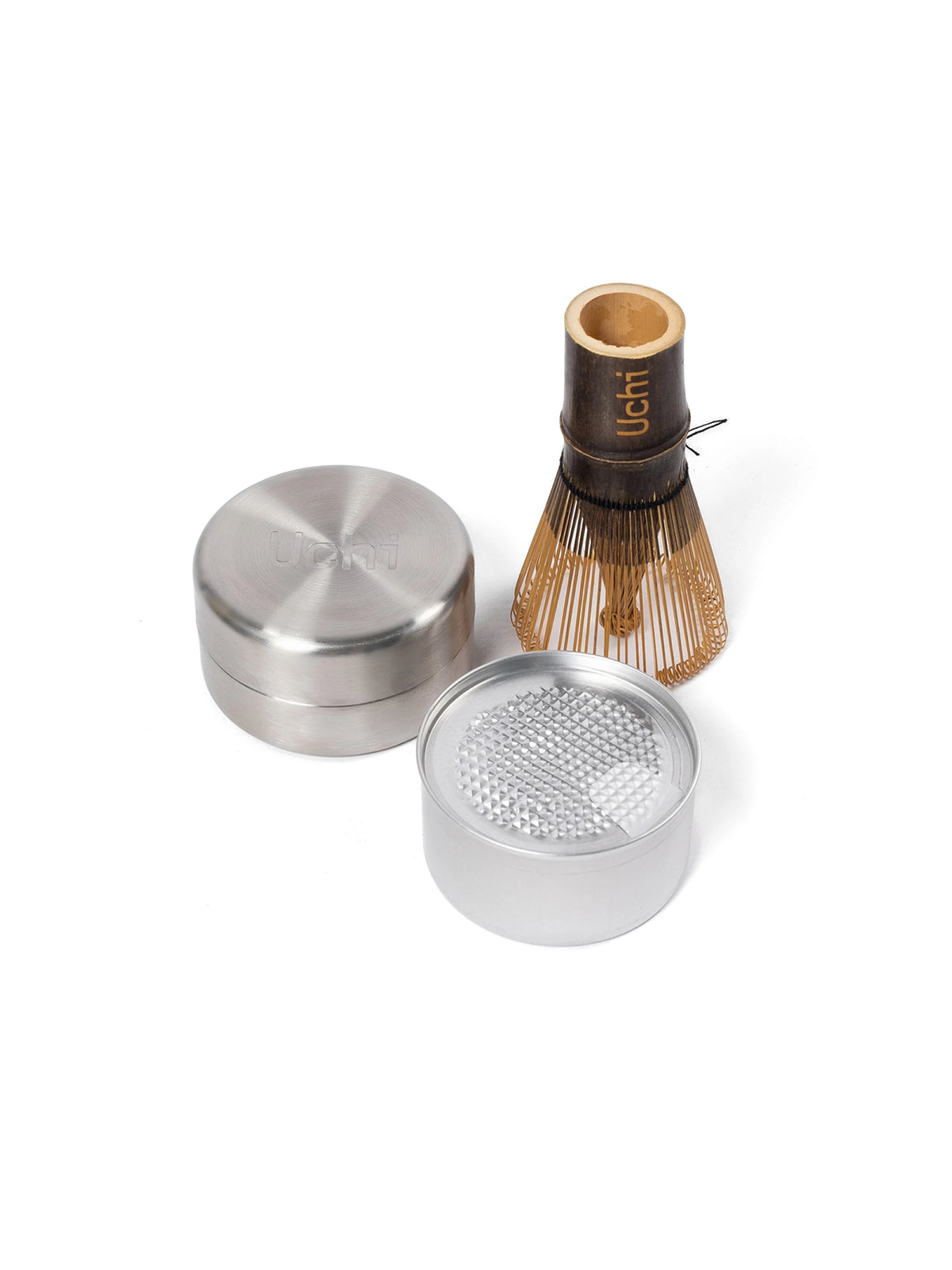
The Uchi Base is an airtight stainless steel matcha canister that keeps light out. Keep it away from heat as well. Stainless steel does not make a position beside the hob suitable for storage.
Uchi suits home matcha drinkers who want airtight storage alongside a repeatable preparation routine. The practical limitation is simple: the container protects stored powder, not powder left sitting in an open bowl.
For this 2026 workflow, consistency means holding the recipe steady enough to notice a deliberate change. It does not mean every bowl must taste identical. Water, preparation and the matcha itself still matter.
Before you start
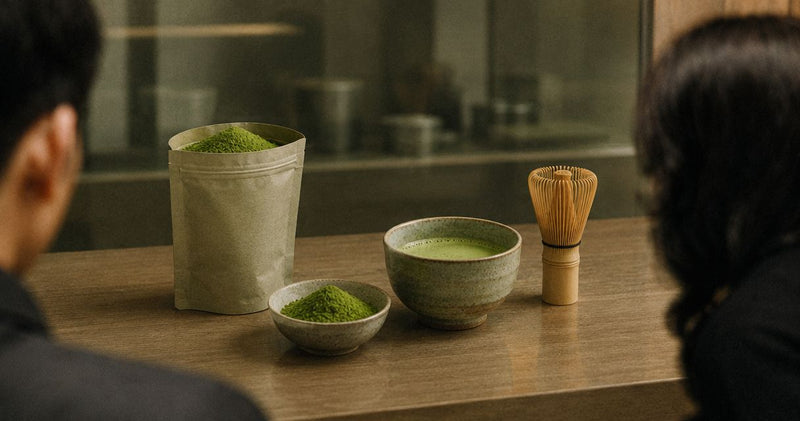
- Gather matcha, a kitchen scale with gram mode, a dry bowl, a dry measuring utensil, a fine-mesh sifter and a bamboo whisk. Check the scale manual for its minimum load and tare instructions.
- Choose a scale that displays 0.1 g increments for small portions. Display resolution is not the same as verified accuracy; a whole-gram display gives little detail when measuring a small serving.
- Keep the weighing bowl dry. Prewarming it first leaves moisture that catches powder. Either weigh before prewarming, using a separate dry vessel, or skip prewarming for this direct-to-bowl workflow.
You do not need an app, an account or a connected scale. The connection is procedural: the same bowl, the same measuring sequence and a short recipe note.
Place the scale on a stable, level surface. Leave enough room to remove the bowl without knocking the matcha container. Keep the dry station separate from the kettle and sink.
Scale and bowl setup
Establish the measuring station
- Place the clean, dry bowl centrally on the scale. Make sure its base sits fully on the weighing platform and does not touch the surrounding counter.
- Select gram mode. Follow the labels on your particular scale rather than assuming its controls match another model.
- Use the tare function to subtract the bowl's weight. Wait for a stable zero reading before adding powder.
- Check that you can still read the display with the bowl in place. If the bowl hides it, change the position before opening the matcha.
Expected result: the bowl sits securely, the display reads zero, and the scale measures only what you add next.
A large bowl is not automatically a problem. Contact with another surface is. A bowl resting partly against a wall or nearby object can transfer some of its weight away from the scale.
For your 2026 recipe note, record the bowl you use and whether you weigh directly into it. This is a preparation detail, not a claim that a particular bowl weight changes the drink.
Choose the starting recipe
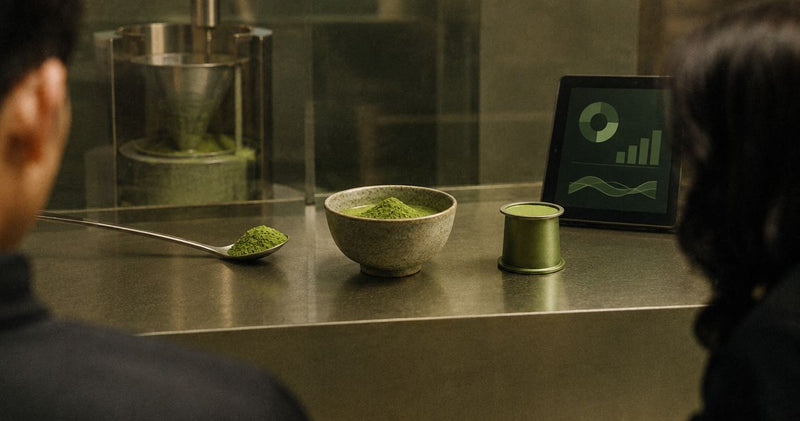
Use 2 g of matcha with 40 g of water as a starting recipe for this guide. This is a recipe choice, not a universal serving rule. Adjust it to taste after making a bowl with the method unchanged.
Weigh water in grams here because the same scale can measure both ingredients. There is no need to switch between a scale and a measuring jug during preparation.
Write the recipe as powder mass followed by water mass. Avoid a note that only says two scoops: scoop shape, levelling and how the powder sits all affect what that means.
Powder portion and storage
Weigh before adding water
- Position the dry sifter above the bowl without letting it rest on an unweighed surface. Alternatively, weigh into the bowl first and sift into a second dry bowl afterward.
- Add powder slowly. Pause between additions so the display can settle rather than chasing a changing reading.
- Stop at your chosen powder mass. If using the starting recipe, that is 2 g.
- Pass the measured powder through the sifter. If powder remains in its mesh, gently work it through without pressing the sifter against the scale platform.
- Close the matcha container. Move it back to its storage position before handling hot water.
Expected result: a measured portion of sifted powder sits in the bowl, and the remaining matcha is closed away.
If you rest the sifter on the bowl during weighing, put both on the scale before taring. Powder caught in the mesh then counts toward the reading, so finish sifting before removing it.
Do not put excess powder from a damp bowl back into storage. Preventing an overshoot is simpler than trying to recover it. Approach the target with smaller additions near the end.
The Pod contains 40 g of matcha, about twenty cups. Actual servings depend on the portion you choose. Treat that quantity as a planning reference, not a reason to change a recipe you enjoy.
Keep the storage step visible
A useful 2026 routine has a clear boundary: powder handling ends before water handling begins. Close the container at that boundary, not after drinking.
Keep the measuring utensil dry between uses. Do not use a utensil that has just stirred a drink to return to the stored powder, even if it appears nearly dry.
Water measurement and whisking
Complete the bowl
- Remove the sifter and any utensil resting on the bowl. Leave only the bowl and measured powder on the scale.
- Tare again. This separates the water measurement from the powder measurement without mental subtraction.
- Add the chosen water mass slowly. For the starting recipe, add 40 g. Use water suitable for the preparation instructions supplied with your matcha.
- Lift the bowl off the scale and place it on a stable surface. Whisk there, not on the weighing platform.
- Whisk with a light back-and-forth motion. Avoid forcing the bamboo tips into the bottom of the bowl.
Expected result: the powder and water have been measured separately, and the finished drink has no obvious dry clumps.
Matcha forms a suspension rather than dissolving completely. Some settling does not mean the scale failed. Sifting addresses clumps; whisking disperses the particles through the water.
The Uchi Whisk is a bamboo chasen with 120 prongs. It serves a different purpose from the scale: one measures the ingredients, the other brings them together. Neither replaces the other.
Taste before changing the recipe. If you alter the powder, water amount and preparation technique together, the next bowl tells you little about which change mattered.
Keep a short recipe note
Record the powder mass, water mass and one plain observation about taste or texture. Use words you recognise tomorrow: too concentrated, too thin, clumpy, or pleasant as prepared.
Your 2026 note does not need a score or a tasting vocabulary. It needs enough detail to repeat the bowl you preferred. Keep the water source and preparation method unchanged while testing a different powder portion.
The Spoon variant for an established recipe
Once a weighed recipe is familiar, the Uchi Spoon offers a simpler daily measure. One leveled Spoon holds 1 gram. Use the same levelling method rather than alternating between level and heaped measures.
Choose weighing when you are adjusting the recipe; choose a leveled measure when you want to repeat an established one. The trade-off is measurement detail versus fewer actions.
| Method | Suited to | Limitation |
|---|---|---|
| Kitchen scale | Small recipe adjustments | Needs setup and a stable reading |
| Leveled Spoon | Repeating an established portion | Depends on consistent levelling |
To use the variant, place the dry bowl on the counter, measure the powder, sift it and close the container. Measure the water separately. Keep the recipe unchanged rather than making a larger scoop compensate for a different water amount.
The principle also applies when weighing tea with a kitchen scale: fixing the leaf quantity makes deliberate recipe changes easier to interpret. Matcha adds a distinction: its powder remains in the drink rather than being removed after steeping.
Return to the scale when changing your recipe or checking a measure that has become inconsistent. There is no need to turn every morning into a calibration exercise.
Troubleshooting
The reading jumps while adding powder
Stop adding powder and let the display settle. Check that the scale sits level, the bowl touches nothing else and no utensil rests against the counter.
If small additions do not register reliably, consult the minimum-load specification. A display with decimal places does not establish how accurately the scale measures a small load.
The scale switches off halfway through
Check the manual for automatic shut-off behaviour. Gather the dry tools before starting so the scale is not waiting while you search for a sifter.
If the scale switches off after powder is added, do not guess the lost reading. Transfer the powder to a dry vessel, re-establish the tare and weigh it again.
Powder sticks to the bowl before whisking
Check for moisture left by washing or prewarming. Dry the bowl completely before weighing the next portion.
For the current bowl, continue preparation rather than scraping wet powder back into storage. Keep dry measuring utensils separate from wet preparation tools.
The measured bowl still has clumps
Check the sifting step. Weighing controls quantity; it does not break apart compacted powder.
Pass the dry portion through the sifter before adding water. Whisk after moving the bowl off the scale, with enough space for the whisk to move freely.
The same portion tastes different
Check the water amount, water source, preparation method and storage conditions before blaming the scale. A repeated powder mass controls only one part of the drink.
In your 2026 recipe note, change a single variable for the next preparation. That makes the comparison useful instead of simply different.
Customize your workflow
For a shared kitchen, keep individual recipe notes rather than one unmarked scoop for everyone. Weigh each person's portion separately until their preferred recipe is established.
For a first purchase, choose by the tools already present. Home contains Base + Pod. Complete contains Base + Pod + Bowl + Spoon + Sieve + Whisk.
| Choice | Suited to | Limitation |
|---|---|---|
| Home | A kitchen with preparation tools | Does not include whisking tools |
| Complete | A kitchen without those tools | Adds tools you might already own |
Neither includes a kitchen scale in its stated contents. Choose that separately if weighing is part of your routine.
Keep the counter arrangement small: dry storage away from heat, weighing space beside it, wet preparation beyond that. The deeper guidance on dry handling of matcha powder covers the separation between powder, damp utensils and steam.
FAQ
How do I measure a matcha portion with a kitchen scale?
Place a dry bowl on the scale, select grams and tare before adding matcha. Weigh the powder, sift it, then tare again before measuring water.
What scale resolution should I choose for matcha?
Choose a scale displaying 0.1 g increments for small matcha portions. Check its minimum load and accuracy specification as well; display resolution alone does not verify accuracy.
How much matcha should I weigh for one bowl?
This guide uses 2 g of matcha with 40 g of water as a starting recipe. Adjust to taste while keeping the other preparation details unchanged.
Should I prewarm the bowl before weighing matcha?
Keep the bowl dry when weighing powder directly into it. If you prewarm the drinking bowl, weigh the powder in a separate dry vessel to avoid moisture catching the powder.
Can I use a Spoon instead of a scale?
One leveled Uchi Spoon holds 1 gram. A leveled measure suits an established recipe; a scale gives more detail when adjusting the portion.
Why does matcha settle even when I weigh it correctly?
Matcha is a suspension, not a fully dissolved drink. Weighing controls quantity, while sifting and whisking address clumps and dispersion.
Does Complete include a kitchen scale?
Complete contains Base, Pod, Bowl, Spoon, Sieve and Whisk. A kitchen scale is not included in those stated contents.
One last thing
The second tare matters as much as the first. Taring again after sifting lets you measure water directly, without subtracting the powder weight or relying on a bowl's fill line.
Keep the same sequence tomorrow. Dry bowl. Measured powder. Closed container. Measured water.