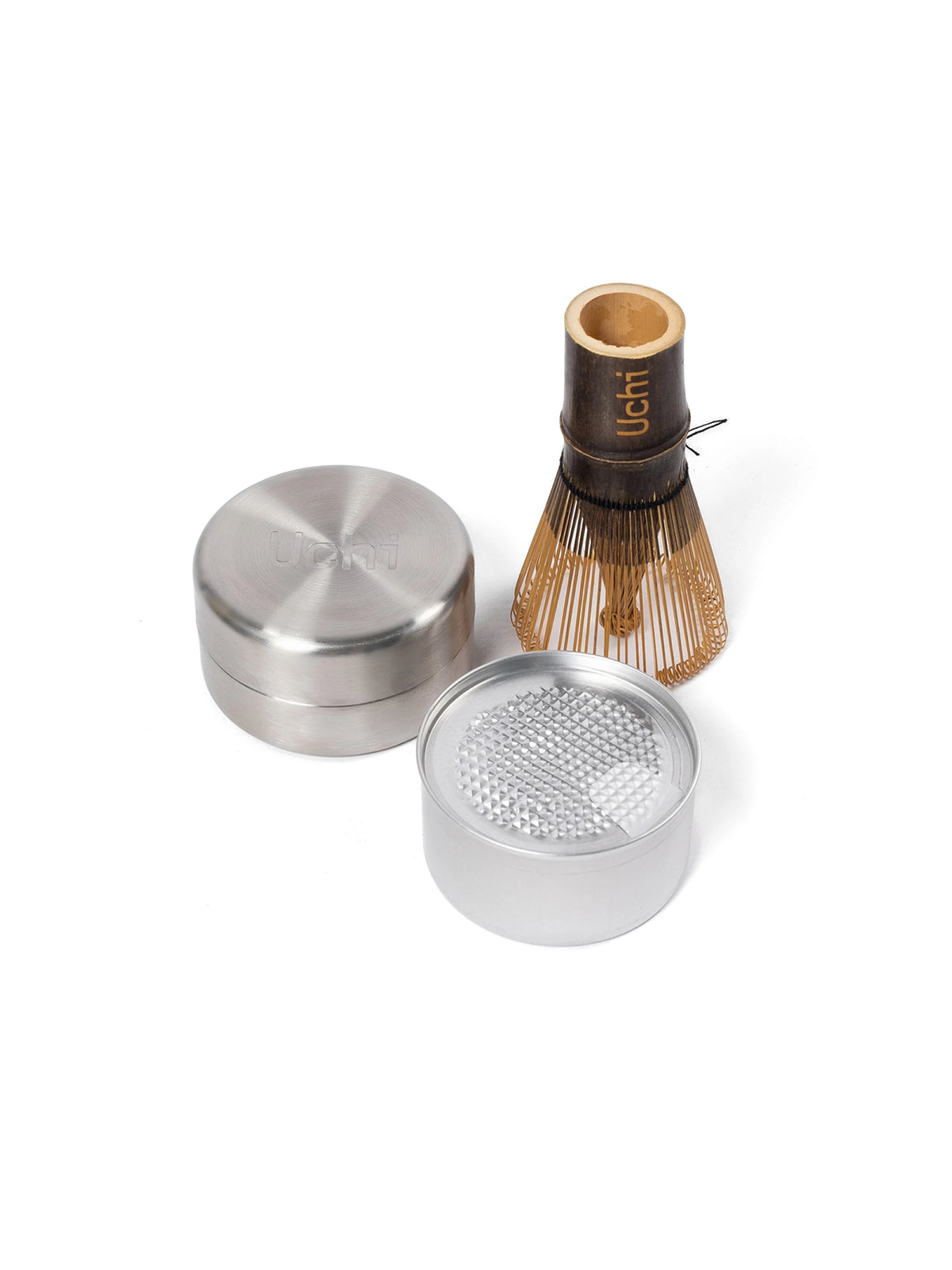
For a matcha sieve in 2026, choose fine mesh for everyday preparation; choose a documented extra-fine screen only when smaller openings serve a clear purpose. The Uchi Sieve suits home matcha drinkers who want a dedicated fine-mesh sifter before whisking.
- Choose a fine-mesh matcha sieve for everyday dry sifting before whisking.
- Extra-fine, fine and coarse describe a relative order, not a verified opening size.
- Uchi Sieve suits home preparation; no numerical mesh specification is stated here.
- A sieve separates clumps. Airtight storage addresses exposure to air and light.
Why this matters
Air, light and moisture affect matcha before the whisk reaches the bowl. Storage protects the powder between servings. A sieve has a different task: separating clumps immediately before preparation.
Those jobs should not be confused. Sifting does not restore faded colour or lost aroma, and a finer screen does not make old matcha fresh again.
Choose the sieve for handling. Choose the container for protection. That distinction matters more than an unexplained mesh number.
What makes a useful matcha sieve
For a home purchase in 2026, assess these five details before comparing mesh descriptions:
- Opening size. A stated aperture describes the opening through which powder passes. “Fine” alone does not provide that measurement.
- Dry powder passage. The screen should separate clumps without requiring forceful grinding against the wires.
- Bowl fit. The sieve should sit or be held securely over the receiving bowl, with room to work.
- Cleaning access. The mesh and rim need to be accessible for cleaning and thorough drying.
- Everyday handling. A comfortable grip and controlled movement matter when transferring a small serving of powder.
A mesh count is not the same thing as an aperture. Mesh count describes openings along a length; wire thickness also affects the size of those openings. Compare like-for-like specifications, not isolated numbers.
Mesh fineness at a glance
The order below runs from nominally finer to coarser screens. It is a guide to sieve types, not a measured ranking of named products. Without comparable aperture specifications, assigning numerical positions to individual brands would imply a precision the descriptions do not establish.
| Sieve type | Suited to | Main limitation |
|---|---|---|
| Extra-fine mesh | Deliberate, controlled sifting | Needs a clear specification |
| Fine mesh | Everyday home matcha | “Fine” is not a measurement |
| Coarse mesh | Checking an existing strainer | Smaller clumps can pass |
The practical default is fine mesh, not the smallest opening available. The purpose is to separate clumps while keeping preparation straightforward.
1. Extra-fine mesh: for a documented smaller opening
An extra-fine sieve belongs at the finer end of this descriptive ranking. The name alone does not establish how much finer it is than another screen. A published aperture is the useful distinction.
Choose this type when there is a specific reason to control what passes through the mesh. Do not assume that a smaller opening automatically produces a more enjoyable bowl.
Extra-fine mesh advantages:
- A documented aperture makes comparison more precise.
- Smaller openings retain clumps that would pass through larger openings.
- A separate dry-sifting stage makes retained material easy to inspect.
Extra-fine mesh limitations:
- Powder can require more patient movement through a smaller opening.
- The term “extra-fine” cannot establish a ranking across brands without specifications.
- A finer screen does not correct stale powder or replace whisking.
Suited to: home drinkers who want a specified aperture and accept a more deliberate sifting step.
Verdict: Hold unless the specification explains the choice. Extra-fine is a description, not a reason on its own.
2. Fine mesh: for everyday home matcha
A fine-mesh sieve separates dry clumps before water is added. It is the straightforward category to consider for a daily bowl, provided it fits the bowl and passes powder without excessive pressure.
Uchi Sieve is a fine-mesh sifter. Its numerical mesh count and aperture are not stated here, so it should not be assigned a measured position against other fine-mesh products.
Fine mesh advantages:
- It addresses clumps before they become wet.
- It creates a separate, visible preparation step.
- It suits a simple sequence of portioning, sifting and whisking.
- A dedicated sifter can be kept apart from wet kitchen tasks.
Fine mesh limitations:
- The word “fine” does not establish an exact opening size.
- The sieve still needs cleaning and complete drying.
- It cannot remove the need to disperse the powder in water.
Suited to: home matcha drinkers who want a dedicated sifting step without choosing equipment around an unexplained number.
Verdict: Choose fine mesh as the everyday default. Check handling and bowl fit before treating greater fineness as an upgrade.
3. Coarse mesh: for assessing a strainer already at home
A coarse kitchen strainer has larger openings than a finer screen within a comparable range. It can catch larger clumps while allowing smaller ones through.
That makes a coarse strainer a useful point of comparison, rather than a dedicated matcha recommendation. Its suitability depends on the actual screen, its condition and how the powder passes through it.
Coarse mesh advantages:
- Larger openings allow powder to pass with less resistance.
- An existing strainer allows a practical handling check before another purchase.
- Larger clumps remain visible on the screen.
Coarse mesh limitations:
- Smaller clumps can pass without separating.
- A broad kitchen strainer can be awkward over a small bowl.
- Shared kitchen use requires attention to cleanliness, dryness and lingering odours.
Suited to: checking whether an existing utensil performs the task adequately.
Verdict: Skip coarse mesh as a dedicated matcha purchase. If a strainer already at home works cleanly and comfortably, judge its result rather than its label.
How this ranking works
This 2026 guide orders sieve categories by their stated relative fineness. The recommendation then considers a different question: which category makes sense for ordinary home preparation.
The criteria are opening size, powder passage, bowl fit, cleaning access and handling. No measured product testing, numerical aperture comparison or brand-by-brand fineness score is implied.
A useful comparison needs the same kind of evidence on both sides. A numerical mesh count for one sieve and the word “fine” for another do not establish which has the smaller opening.
Sifting without adding another problem
Sifting works on dry powder. Keep water, steam and a damp spoon away from the open container, then prepare the portion separately.
A leveled Uchi Spoon holds 1 gram. That gives a reference for portioning, not a universal serving prescription. Use the amount appropriate to the drink being prepared.
Portion first
Place a clean, dry sieve above the receiving bowl. Take out the intended portion, then close the matcha container before continuing.
This keeps the remaining powder separate from the wet preparation area. There is no benefit in leaving the container open while arranging the other tools.
Separate gently
Move the powder across the mesh with gentle pressure from a suitable dry utensil. Avoid scraping hard against the wires or using the sieve as a grinding surface.
The aim is to separate clumps. If material remains, inspect it rather than forcing everything through indiscriminately.
Add water afterwards
Set the sieve aside before adding water. Whisk the sifted powder in the bowl, keeping the mesh out of the wet preparation stage.
Matcha is a suspension of leaf particles, not a powder that dissolves completely. Sifting helps separate clumps; whisking disperses those particles in water. Settling is not proof that the sieve failed.
The Whisk is a bamboo chasen with 120 prongs. It performs a different job from the Sieve, and neither tool replaces the other.
Dry before putting away
Remove loose residue and clean the sieve according to its care instructions. After washing, allow the mesh and rim to dry completely before storage or reuse.
For the surrounding preparation area, the guide to dry handling of matcha powder explains why damp scoops and nearby steam deserve attention.
Storage before fineness
A sieve cannot protect matcha while it waits between servings. Air and light belong to the storage decision, not the mesh decision.
The Base is an airtight stainless steel canister, kept for life. The Pod contains 40g of matcha, about twenty cups, in recyclable aluminium. These are distinct parts: the Base is the lasting container; the Pod is the matcha itself.
Close the container after taking a portion. Keep the preparation tools dry, and avoid leaving open matcha beside a steaming kettle.
Recyclable aluminium is a material description, not a claim that every part of the packaging has been resolved. The foam insert remains a separate material consideration.
For a first home arrangement in 2026, choose by the tools already present:
- Home: Base + Pod. Suited to someone who already owns the preparation tools.
- Home + Whisk: Base + Pod + Whisk. Suited to someone who needs the bamboo chasen but already has the other tools.
- Complete: Base + Pod + Bowl + Spoon + Sieve + Whisk. Suited to someone assembling storage and preparation together.
The limitation is duplication. Complete includes tools an established home drinker might already own; Home does not include the Sieve or Whisk. Choose the arrangement that fills the actual gap.
Choosing a matcha sieve in 2026
Start with the task, not the smallest advertised opening. A dedicated fine-mesh sifter is the clear default for separating dry clumps before whisking.
Then check the physical details. Hold it over the bowl it will be used with. Look for a comfortable position, controlled powder transfer and accessible mesh.
Choose a documented extra-fine screen only when its specification answers a particular need. Keep a coarse strainer only if it already performs adequately; do not buy one expecting finer sifting.
The useful purchase is the sieve that fits the preparation, not the one with the most impressive-looking mesh claim.
FAQ
Which matcha sieve should I choose in 2026?
Choose a fine-mesh sieve for everyday home preparation. Check that it fits over the bowl, handles comfortably and can be cleaned and dried thoroughly.
Is an extra-fine matcha sieve always the right choice?
No. A smaller opening can require more patient sifting, and an extra-fine label alone does not establish a measurable difference. Compare stated apertures when available.
What mesh number should a matcha sieve have?
There is no number established by this guide as a universal requirement. Mesh count and aperture are different specifications, so compare equivalent measurements rather than isolated numbers.
Can I use a kitchen strainer for matcha?
Yes, if its mesh separates the clumps and it is clean, dry and comfortable over the bowl. A coarse screen can let smaller clumps pass, so assess the result rather than the utensil's name.
Does sifting make matcha dissolve?
No. Matcha consists of leaf particles dispersed in water rather than completely dissolved material. Sifting separates dry clumps; whisking disperses the powder.
Does the Uchi Sieve have a stated mesh count?
No numerical mesh count or aperture is stated here for the Uchi Sieve. It is described as a fine-mesh sifter, without a measured fineness ranking against other products.
Should I sieve the whole container at once?
Sieve the portion being prepared rather than making the whole container part of the preparation step. Close the remaining matcha before adding water or whisking.
How should I clean a matcha sieve?
Follow the sieve's care instructions and let the mesh and rim dry completely after washing. Keep a wet sieve away from stored matcha and dry powder.
One last thing
A smooth-looking layer of sifted powder says something about preparation, not freshness. Colour and aroma still deserve attention before water is added.
Close the container first. Then give the bowl your attention.