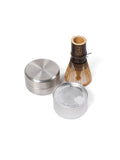
Instead of stirring dry powder around ice, make blender iced matcha by dispersing sifted matcha in cold liquid first, then pouring it over ice. This 2026 workflow keeps the powder protected between servings and separates blending from chilling, so clumps are easier to find and correct.
- For blender iced matcha, blend sifted powder with cold liquid before adding ice.
- Uchi suits home matcha drinkers who want first-harvest matcha and a permanent storage canister.
- Matcha forms a suspension, not a solution; some settling is normal.
- Follow the blender’s minimum liquid requirement, even when making one glass.
Why this matters
Air and light affect matcha before the blender enters the process. Protect the powder first. An airtight, opaque container limits exposure between drinks; leaving it open beside a wet blender works against that protection.
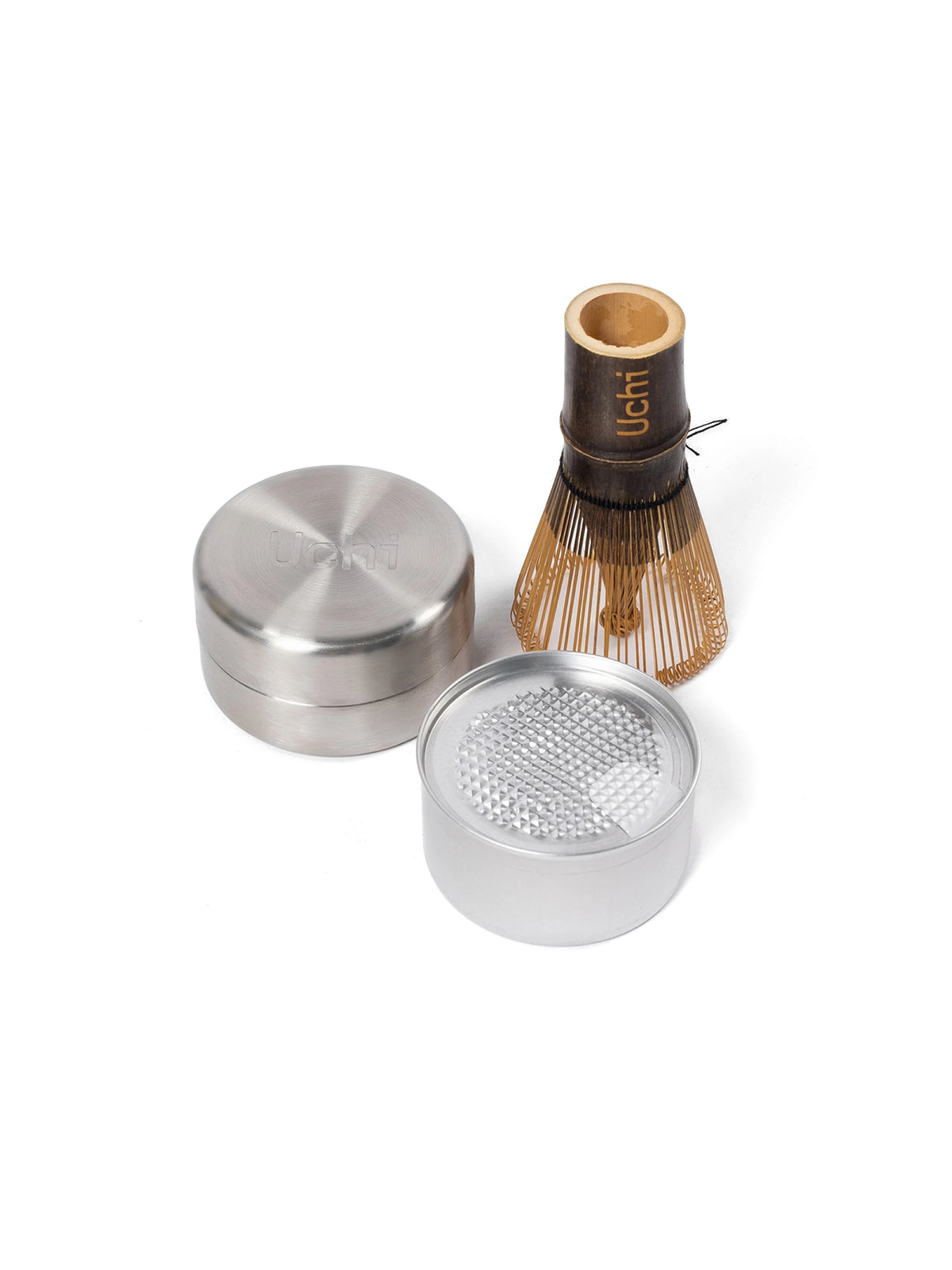
The Uchi Base is an airtight stainless steel canister, kept for life. Keep it away from heat, close it after measuring, and return to the drink. A canister protects stored powder. It cannot restore flavour already lost through poor storage.
Uchi suits home matcha drinkers who want first-harvest matcha and a permanent storage canister. The preparation still matters: adding dry powder to a glass crowded with ice makes it harder to disperse evenly.
Matcha does not dissolve like sugar. The blender distributes fine leaf particles through liquid. That distinction explains both the smooth initial drink and the sediment that can appear later.
Before you start
- Check the blender manual. Confirm that the appliance handles your intended ingredients, meets its minimum liquid requirement, and permits ice crushing if you intend to blend ice. A small drink can sit below the blades in a large jug.
- Gather dry measuring tools and a clean vessel. Have matcha, a fine-mesh sifter, cold water or milk, ice, and a serving glass ready. Keep the powder container outside the splash area.
- Separate powder handling from wet preparation. Measure and sift before handling ice or rinsing equipment. A damp spoon introduces moisture into the stored powder; a cold container opened too soon after refrigeration can collect condensation.
A repeatable starting portion
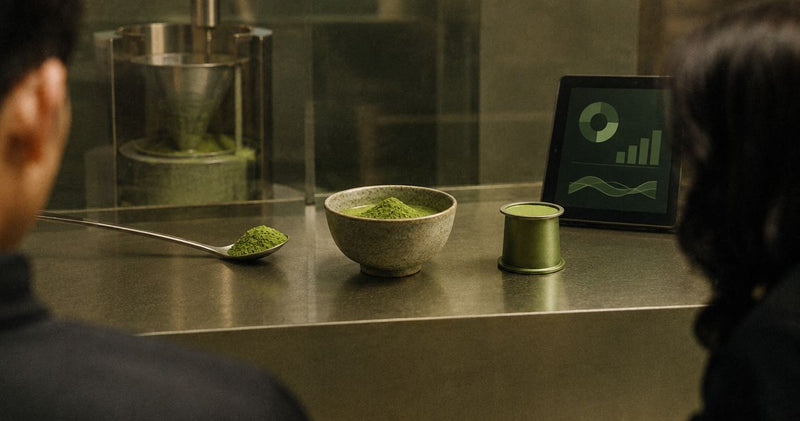
Use the serving quantity you already enjoy. If you need a starting point, the Pod contains 40g for about twenty cups, equivalent to about 2g per cup. This is a portion reference, not a fixed recipe for every glass.
One leveled Uchi Spoon holds 1 gram. Two leveled Spoon measures therefore give that approximate starting portion. A scale also works, especially when comparing drinks made in different glasses.
Choose the liquid quantity around the blender’s operating requirements and your preferred strength. Do not run a large jug with too little liquid simply to preserve a single-serving recipe. Change the vessel or make enough to reach the stated minimum.
For a repeatable 2026 kitchen routine, record the powder amount and liquid quantity together. Changing both at once makes taste adjustments harder to interpret.
Powder preparation
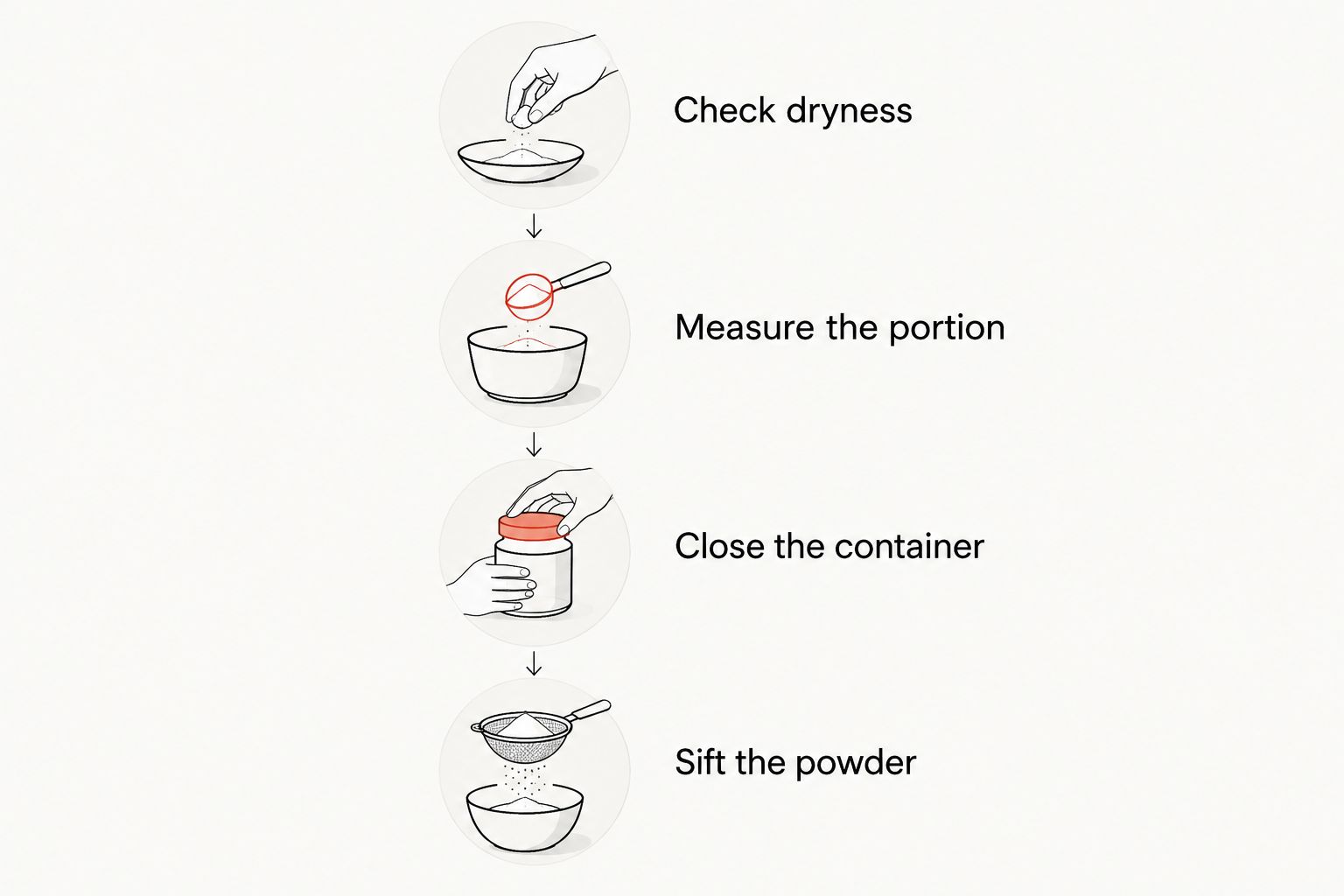
The first configuration unit is the dry station: powder, measure, sifter, and an empty receiving vessel. Finish this stage before opening the blender beside the sink.
- Check dryness. Inspect the measuring tool and sifter. Both must be dry before they touch the powder.
- Measure the portion. Take the amount needed for the drink without leaving the storage container open while arranging other equipment.
- Close the container. Put the stored powder away from steam, direct sunlight, and the blender’s splash area.
- Sift the powder. Pass the measured portion through a fine-mesh sifter into a dry vessel. Break up soft clumps gently rather than forcing damp lumps through the mesh.
Expected result: a measured portion of loose powder, with the remaining matcha closed and protected. If the powder forms persistent damp lumps, stop and inspect the storage conditions rather than treating blending as the only fix.
Sifting addresses clumps before liquid makes their centres harder to reach. It does not change the fact that leaf particles remain suspended in the drink.
Blender setup
The second configuration unit is the liquid and blade assembly. The goal is circulation through the powder, not simply a motor running beneath it.
- Add cold liquid according to the loading order and minimum quantity specified by the blender manufacturer. If the manual permits either order, begin with liquid so dry powder does not sit beneath it against the vessel.
- Add the sifted matcha. Keep loose powder away from the rim and sealing surfaces.
- Fit the lid or blade assembly exactly as the manual directs. Check that the vessel is secure before starting.
- Use the manufacturer’s appropriate blending setting. Stop when the liquid looks evenly green and no dry pockets remain. A fixed universal speed or duration does not apply across different machines.
- Stop the motor fully before inspecting. If powder remains on the walls, disconnect the appliance before using a suitable utensil to bring it back into the liquid.
Expected result: evenly coloured liquid without visible dry islands or powder trapped beneath the blades. Foam can sit above that liquid; do not mistake a pale foam layer for unblended powder.
Blend to an observable result, not an arbitrary timer. A narrow personal blender and a large countertop jug move small quantities differently. The manual sets the operating limits; the drink shows whether dispersion is complete.
Do not extend blending merely to remove every bubble. Blending introduces air, and more blending is not a reliable way to produce less foam.
Ice and serving
The third configuration unit is the glass. Keep ice out of the initial blending stage when the intended result is liquid iced matcha rather than a crushed-ice drink.
- Prepare the serving glass with ice after the matcha is dispersed. Keep any wet ice utensil away from the stored powder.
- Pour the blended matcha over the ice. Leave enough room to stir without spilling.
- Taste before making further additions. Adjust the liquid quantity if the drink is too concentrated.
- Stir before drinking if the mixture has separated while standing. Rinse the blender promptly, then clean it according to the appliance instructions.
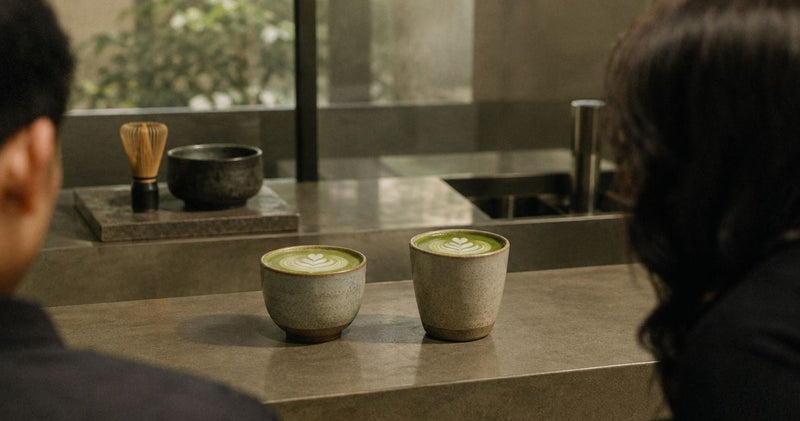
Expected result: a cold, pourable drink with intact ice and no visible dry clumps. The texture is liquid, not spoonable.
Ice melts and changes the concentration. Judge the drink in its serving glass rather than tasting only the undiluted mixture in the blender.
For this 2026 workflow, keep one preparation note: the powder amount, the liquid quantity, and the glass used. That gives the next drink a clear starting point without turning breakfast into a laboratory exercise.
Milk-based blender iced matcha
For a milk-based drink, use the same dry preparation and storage steps. Milk changes the flavour and foam, but it does not remove the need to disperse the powder.
Two adjacent workflows are useful. Neither requires blending ice.
| Workflow | Suited to / trade-off |
|---|---|
| Blend with milk | Suited to a combined drink. Simple pouring; foam varies with the milk. |
| Blend with water, add milk | Suited to separate control. Easier to adjust milk later; requires another addition. |
Blend with milk
Add the milk and sifted powder using the blender’s permitted loading order. Meet the minimum liquid requirement and blend until no dry pockets remain, then pour over ice.
This removes a separate mixing stage. The trade-off is foam: the milk and machine affect how much forms, so inspect the liquid beneath it before deciding the drink needs more blending.
Blend with water, add milk
Disperse the powder in cold water first. Pour it over ice, then add milk and stir for an even drink.
This keeps the milk addition separate from powder dispersion. The limitation is vessel size: a large blender might require more water than you want in the finished drink. Do not ignore its minimum fill requirement to make a concentrated base.
Choose one method and repeat it before changing ingredients. A different milk and a different powder-to-liquid ratio are separate adjustments, even when both happen in the same glass.
Troubleshooting
Powder sticks above the liquid
Stop the blender and disconnect it before opening or scraping. Bring the powder into the liquid with a suitable utensil, reseal, and blend again within the manufacturer’s instructions.
Check loading order and fill level before the next drink. Powder left high on the walls cannot disperse while it remains outside the circulating liquid.
Clumps remain in the glass
Sift the next portion before blending. Check that the powder, spoon, and sifter were dry, and confirm the blender moved the full mixture rather than leaving a still layer around the edges.
Do not assume every dark speck is a dry clump. Matcha contains leaf particles. A clump has an unincorporated centre; fine sediment is a different issue.
The drink separates after standing
Stir the drink. Matcha is a suspension, so settling does not by itself mean the blender failed.
The guide to matcha settling rather than dissolving explains the distinction. Chasing permanent suspension with longer blending adds another variable without changing what matcha is.
The drink has too much foam
Let the foam settle before serving, or hold some back while pouring. Next time, stop once the powder is dispersed rather than continuing solely for reassurance.
If using milk, keep the same milk while adjusting the blending approach. Otherwise it becomes difficult to identify which change affected the texture.
The flavour is dull or too strong
Check concentration first. Add liquid to a drink that is too strong, then record the adjustment for the next serving.
For dull flavour, inspect storage and taste the matcha in a simpler preparation. Blending cannot reverse staling. Keep the container closed between uses and away from the kettle or hob.
Customize your workflow
Keep storage, portioning, and blending separate. This makes each adjustment easier to trace. A wetter spoon is a storage problem; a still layer beneath the blades is a circulation problem.
A home setup does not need every preparation tool for every drink. Home contains Base and Pod. Complete contains Base, Pod, Bowl, Spoon, Sieve, and Whisk.
Home suits someone who already owns suitable preparation tools. Its limitation for this workflow is straightforward: the sifter and measuring tool must come from elsewhere. Complete suits someone building both blended and hand-whisked preparation into the same kitchen. Its limitation is more objects to store and clean.
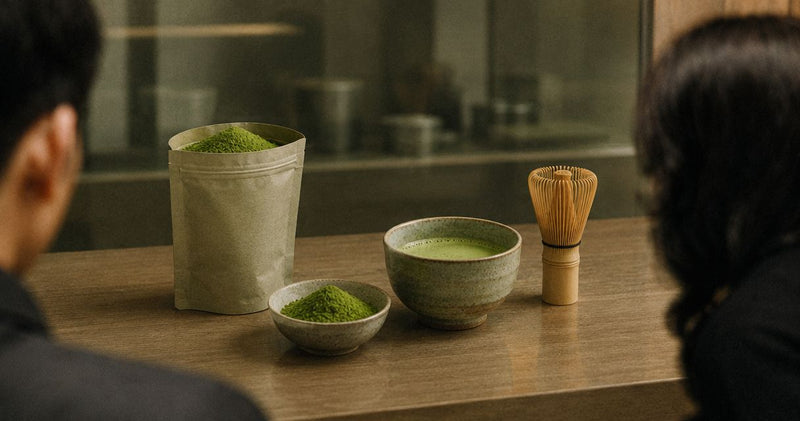
Neither includes a blender. The Whisk is a bamboo chasen with 120 prongs; it serves the hand-whisked preparation, not the motorised one.
In 2026, choose around the preparation you actually repeat. Start with the missing function rather than adding equipment because it appears in a photograph.
FAQ
Can I make iced matcha in a blender?
Yes. Blend sifted matcha with cold liquid until evenly dispersed, then pour over ice. Follow the blender’s loading instructions and minimum liquid requirement.
Should I put ice in the blender with matcha?
Leave ice out when you want liquid iced matcha with intact ice. Blending ice creates a different texture and requires an appliance approved for ice crushing.
Do I need hot water for blender iced matcha?
No. Cold liquid works for this workflow when the blender disperses the powder properly. Sift first and check for dry pockets before serving.
How much matcha should I use for one glass?
About 2g is a starting portion derived from a 40g Pod making about twenty cups. Adjust the liquid quantity and powder amount to suit the finished drink and the blender’s operating requirements.
Why does my blended matcha settle?
Matcha settles because leaf particles form a suspension rather than dissolving. Stir before drinking; fine sediment alone does not indicate failed blending.
Can I blend matcha directly with milk?
Yes. Blend sifted matcha with milk if the appliance permits that use and the quantity meets its minimum fill requirement. Expect the amount of foam to vary with the milk and machine.
Does Uchi Complete include a blender?
No. Complete contains Base, Pod, Bowl, Spoon, Sieve, and Whisk. A blender is a separate appliance for this workflow.
One last thing
For your next drink in 2026, inspect the liquid before adding ice. That small pause separates a blending problem from normal settling and dilution.
The useful checkpoint is the absence of dry powder, not the absence of sediment. Once the mixture is evenly dispersed, pour. Keep the remaining powder closed, dry, and away from heat.