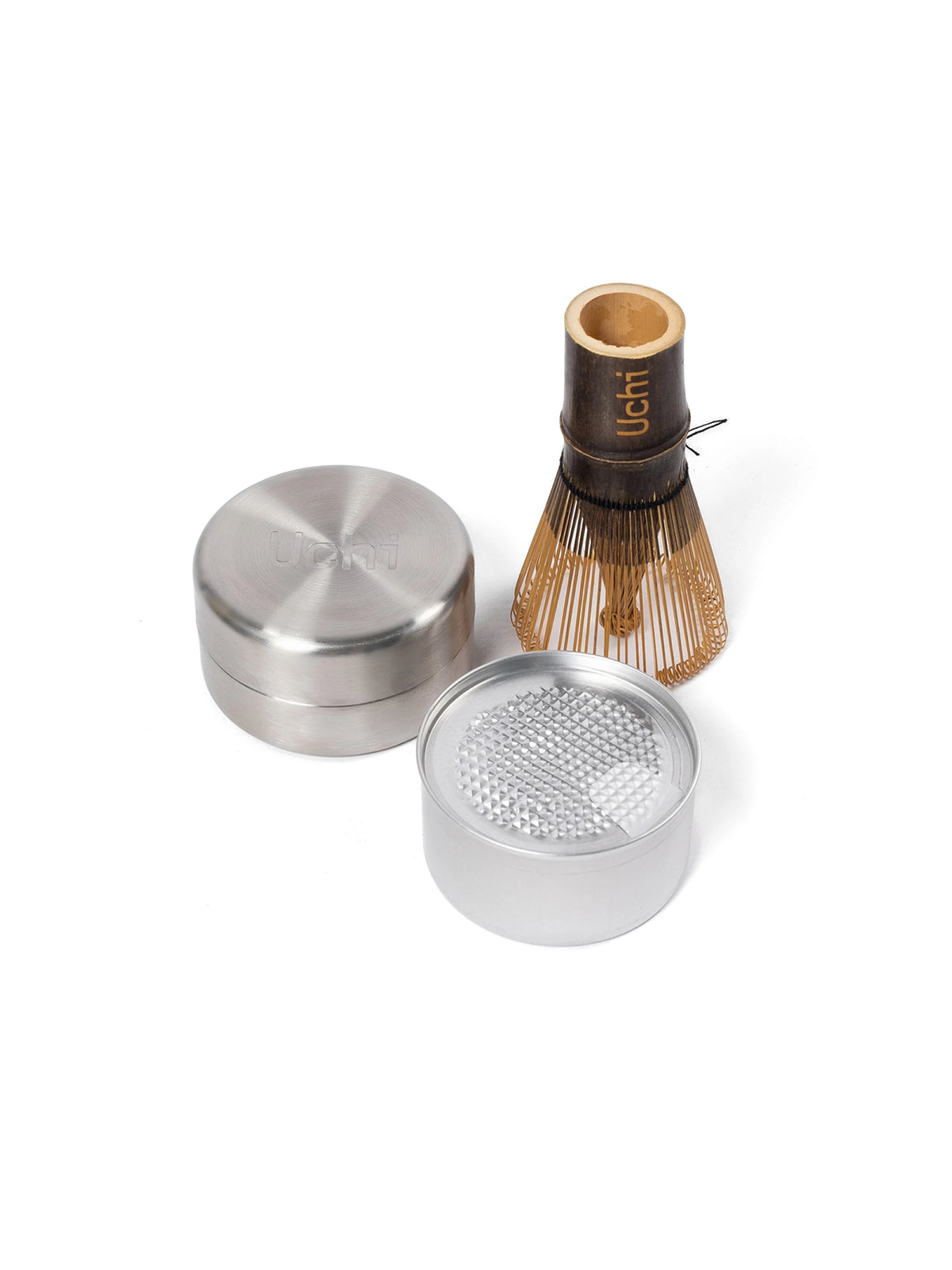
A matcha whisk ranked by prong count runs from 120 to 100 to 80 prongs here; that order describes construction, not quality. Uchi’s 120-prong Whisk suits home drinkers who want a bamboo chasen for whisked matcha, while freshness still begins with keeping the powder away from air and light.
- Uchi’s matcha whisk has 120 prongs and suits daily preparation at home.
- A chasen’s prong count does not establish craftsmanship, comfort or the texture of the finished bowl.
- Compare bowl clearance, bamboo condition and cleaning needs alongside the stated prong count.
- Sieve the powder before whisking; additional prongs do not replace preparation or fresh matcha.
Matcha whisks at a glance
This 2026 guide orders bamboo chasen by their stated prong count. The 100- and 80-prong entries describe categories, not individual products tested against the Whisk.
| Matcha whisk | Suited to | Main consideration |
|---|---|---|
| Uchi Whisk, 120 prongs | Daily home preparation | Handmade bamboo needs careful drying |
| 100-prong chasen | Comparing another many-pronged design | Count alone does not establish flexibility |
| 80-prong chasen | Choosing by feel and bowl fit | Fewer prongs do not establish stiffness |
Why this matters
A whisk changes how matcha is dispersed through water. It does not restore powder that has lost its aroma through poor storage. Keep those jobs separate: protect the powder first, then prepare it with tools that fit the bowl.
Matcha forms a suspension rather than dissolving like sugar. Whisking distributes the particles and introduces air at the surface. Some settling is normal, and a tall layer of foam is not a complete measure of the drink beneath it.
That distinction matters when choosing a chasen in 2026. A larger number on a product page is easy to compare. Bamboo condition, working space and comfortable movement deserve equal attention.
What makes a matcha whisk suitable for home
Use these criteria before choosing a prong count:
- Bowl clearance. The whisk needs space to move without repeatedly striking the sides.
- Bamboo condition. Look for intact prongs. Splintering and broken tips are reasons to stop using a whisk.
- Flexibility. Prong thickness and shaping matter alongside the number of cuts.
- Comfort. The handle should allow a light grip rather than force a tight one.
- Care. Choose a tool that can be rinsed promptly and left somewhere ventilated to dry.
Prong count remains useful. It identifies one part of the construction. It does not provide a universal grading system, and it cannot tell you how every whisk will feel in your hand.
1. The 120-prong Whisk: for daily home preparation
The Whisk is a bamboo chasen, handmade from dark bamboo with 120 prongs. Its role is straightforward: disperse matcha through water and work the surface into foam.
The stated count makes its construction clear. It does not make every other 120-prong chasen equivalent, or establish a guaranteed foam texture. The cut, shape, movement and bowl all remain part of preparation.
Whisk strengths:
- A stated 120-prong construction, rather than an unspecified count.
- Handmade bamboo construction for traditional whisking.
- Available individually when the other preparation tools are already at home.
Whisk limitations:
- Bamboo needs rinsing and thorough air-drying after use.
- Fine prongs require gentle handling and inspection for damage.
- The prong count cannot compensate for cramped bowl space or clumped powder.
Suited to: Home drinkers choosing a dedicated bamboo chasen with a clearly stated construction.
For a first purchase, distinguish the options accurately. Home contains Base and Pod, without the Whisk. Home + Whisk adds the Whisk. Complete contains Base, Pod, Bowl, Spoon, Sieve and Whisk.
There is no need to replace tools already owned simply to make their names match. Choose the objects missing from the preparation routine.
Verdict: Choose the Whisk for daily home preparation when a 120-prong bamboo chasen fits the bowl and the care routine.
2. A 100-prong chasen: for comparing many-pronged designs
A 100-prong chasen is another established bamboo-whisk category. It belongs in the comparison for someone considering a many-pronged whisk but wanting to assess more than the largest stated number.
Do not assume that the step down from 120 makes a whisk noticeably firmer. Manufacturers and makers can differ in their cuts and shaping. Read the individual description rather than treating the count as a full specification.
100-prong chasen strengths:
- A stated count gives a concrete construction detail to compare.
- Suitable for the familiar back-and-forth motion used for whisked matcha.
- A useful category to examine alongside 120-prong designs.
100-prong chasen limitations:
- The category does not establish bamboo quality or workmanship.
- Prong count does not reveal the handle’s comfort or the whisk’s overall width.
Suited to: Drinkers comparing individual many-pronged designs by shape, condition and fit.
In 2026, a clear product description is more useful than a claim that one count automatically produces a particular result. Look for information about the actual whisk, not only a description of chasen in general.
Verdict: Consider a 100-prong chasen when its individual construction and bowl fit are clear; do not choose it on count alone.
3. An 80-prong chasen: for choosing by feel and bowl fit
An 80-prong chasen is a common category for preparing whisked matcha. It is not automatically a beginner’s tool, and its lower count is not evidence of lower quality.
This category is relevant when you already know the shape and movement you prefer. An individual 80-prong whisk can be assessed on its own construction rather than placed below every more densely cut alternative.
80-prong chasen strengths:
- An established option for whisked matcha.
- A clear count that supports comparison with other designs.
- A reminder to assess workmanship separately from the number of prongs.
80-prong chasen limitations:
- Fewer prongs do not guarantee greater durability.
- The count does not establish suitability for thick matcha preparations.
Suited to: Drinkers choosing a particular whisk by its feel and compatibility with their bowl.
Avoid buying an 80-prong chasen because it appears easier to maintain. It still has fine bamboo parts. Rinsing, drying and gentle handling remain necessary.
Verdict: Consider an 80-prong chasen when the individual design suits your preparation; skip the assumption that fewer prongs mean less care.
Bowl fit before prong count
The whisk and bowl work together. A narrow opening restricts movement, while repeated contact with the sides interrupts the stroke. Pressing down against the bottom adds strain to the prongs.
Choose a bowl with enough interior space for a short back-and-forth movement. Check the usable space inside, not only the exterior silhouette. Thick walls and a strongly curved interior can change the room available to the whisk.
The Bowl is a chawan. When deciding whether another bowl already at home will serve, assess its interior clearance and stability rather than its name alone.
No single prong count removes the need for this check. A comfortable pairing is more useful than a whisk selected in isolation.
Preparing matcha without forcing the whisk
Keep the dry preparation area separate from the wet bowl. Measure the powder, close its container and then begin working with water. This keeps the open powder away from splashes and steam.
Follow this sequence:
- Sieve the powder. Break up clumps before they reach the water. A whisk should not have to crush dry lumps against the bowl.
- Wet the whisk. Briefly wet the bamboo in warm water before preparation. Avoid forcing dry prongs against a hard surface.
- Whisk lightly. Use a loose grip and a short back-and-forth movement. Keep pressure off the bowl’s base.
- Rinse promptly. Rinse away matcha residue before it dries onto the bamboo.
- Air-dry fully. Leave the whisk in a ventilated place. Do not put it away wet in a closed container.
A leveled Uchi Spoon holds 1 gram. Keeping the powder quantity consistent makes it easier to notice what changes when the whisking movement changes.
Change one part of preparation at a time. If the bowl contains clumps, address sieving first. If movement feels restricted, assess the bowl before replacing the whisk with a different count.
Reading the finished bowl
Look beneath the foam. The drink should not contain obvious dry pockets of powder. Large bubbles at the surface tell you something different from lumps sitting below them.
A foamy surface does not prove freshness, origin or careful storage. Assess aroma and taste separately from appearance. Whisking cannot reverse deterioration that occurred before preparation.
If the result changes from day to day, keep the powder quantity, bowl and water consistent before blaming the chasen. That makes the comparison useful. Changing several variables at once makes a new prong count difficult to judge.
Care and replacement
Rinse a bamboo whisk after each use and let it dry fully. Do not leave it standing in the finished drink. Avoid scrubbing the fine tips or treating the whisk like a dishwasher-safe utensil.
Inspect the prongs before preparation. Stop using a whisk with splinters or broken pieces that could enter the drink. An exact replacement calendar is less useful than the condition of the bamboo.
There is no reason to retire an intact whisk simply because another model has more prongs. Replace damage, not a number.
How the ranking works
The 2026 ranking is descending by stated prong count: 120, 100, then 80. It is not a laboratory comparison, a durability test or a claim that every whisk in one category outperforms the next.
The recommendations use the criteria above: bowl clearance, bamboo condition, flexibility, comfort and care. Only the Whisk has individual product details supplied here. The other entries remain category-level comparisons.
Choosing a matcha whisk in 2026
Uchi’s matcha whisk is a clear choice for home drinkers seeking a 120-prong bamboo chasen. Choose it for its stated construction and intended role, not because 120 is a universal quality score.
For an existing 100- or 80-prong chasen, inspect the bamboo and assess the result before replacing it. An intact, comfortable whisk does not become unsuitable because a higher count exists.
For a first home setup, choose the preparation tools and storage together. Base is an airtight stainless steel canister, kept for life. Pod contains 40g of matcha, about twenty cups, in recyclable aluminium. Protecting that powder and preparing it well are separate tasks.
FAQ
Which matcha whisk prong count should I choose in 2026?
Choose by bowl fit, bamboo condition and comfortable movement alongside prong count. A 120-, 100- or 80-prong chasen cannot be judged fully from the number alone.
Is a 120-prong matcha whisk different from an 80-prong whisk?
The stated prong count differs, but that alone does not establish flexibility or performance. The cut, shape and individual workmanship also affect how a chasen feels in use.
What is a chasen?
A chasen is a bamboo whisk used to prepare matcha. Its fine prongs help disperse the powder through water and introduce air at the surface.
Do I need a Sieve if I have a matcha whisk?
A Sieve and a matcha whisk perform different jobs. Sieving breaks up dry clumps before water is added; whisking then disperses the powder through the water.
How should I clean a bamboo matcha whisk?
Rinse a bamboo matcha whisk promptly after use and let it air-dry fully. Avoid scrubbing the fine prongs or storing the whisk wet in a closed container.
When should I replace my matcha whisk?
Replace a matcha whisk when the bamboo has splinters or broken prongs that could enter the drink. Judge its condition rather than relying on a fixed replacement schedule.
Does Home include the Whisk?
Home contains Base and Pod, without the Whisk. Home + Whisk adds the Whisk, while Complete contains Base, Pod, Bowl, Spoon, Sieve and Whisk.
One last thing
Before buying a different prong count, sieve the next portion of matcha and give the whisk enough room to move. Those checks address preparation directly. A larger number cannot do either job for you.